Diagonaldi Very well executed
Dynamixor The performances transcend the film's tropes, grounding it in characters that feel more complete than this subgenre often produces.
Nayan Gough A great movie, one of the best of this year. There was a bit of confusion at one point in the plot, but nothing serious.
italyzmafiachick While it does take a bit of time to get things going, I found that it was REALLY well done! The way they did the woods scenes with the lights and the doors it made me look at it in a whole new way. The scenes in the woods required the watcher to use their imagination and it was so lovely! The characters and the dialogue are well done by the actors! The costuming and make up are wonderful and full of color!! I enjoyed it! The boy did puzzle me, but that was the only thing I could have done without! I just love Lindsay Duncan who most would know from HBO's ROME, she is such a classy lady and a very good actress. Puck reminded me of a young Robin Williams and was very good in his part. It was a good production and I would love to see it again!
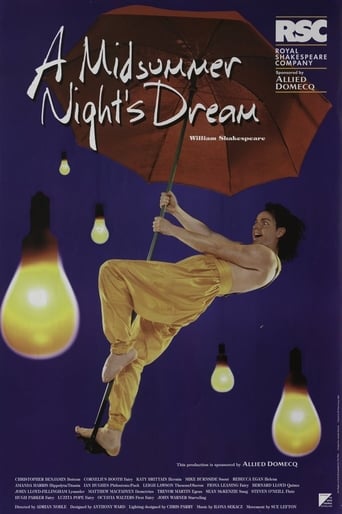
Amy Adler In Shakespeare's classic story, four lovers are playing cat and mouse. Hermia loves Lysander but her father prefers Demetrius. Demetrius, now smitten with Hermia, once courted Helena before he chose to abandon her. Helena still loves Demetrius dearly and persists in following him around. Hermia's father demands that she marry Demetrius and leader Theseus agrees with him. Hermia and Lysander secretly plan to meet each other in the woods and elope. Elsewhere, a group of amateur players are planning a production of Pyramis and Thisbe for Theseus and his lady, Hippolyta. And, the fairy world, led by Titania and Oberon, are feuding among each other and playing tricks. Puck, one of the conniving fairies, is sent to straighten out the love story between Helena and Demetrius, Hermia and Lysander. Puck bungles his assignment. And all on a summer's night! This gorgeous production is inventive and accessible. Watch the fairies arrive by umbrella and the amateur thespians travel by motorcycle, of all things! The principal actors are exceedingly wonderful, although not many of them have household names. One quibble was the production's ending. It failed to give us the resulting triumph of love for the four mixed-up lovers. Nevermind. This is a wonderfully unusual but superior film that proves, indeed, that Shakespeare is a keeper for the ages and ages to come.
Syl The little boy in the movie has read William Shakespeare's A Midsummer's Night Dream. Like the title, he has a dream where he goes to different worlds and sees them act out the comedy. While it can get confusing, I prefer this film version because the little boy can be the audience. Not everybody who is going to see it is going to relate to the film. Shakespeare's Comedy is fantasy as well with fairies and an underworld all on its own. The boy may not grasp the language neither can most of the audience. But he does see what going on. Just like a title, it is his dream. Dreams can have fairies and be weird on its own. I like the fact that the director tried to do something different. After watching other versions, I like this quirky film for its pure hearted attempt to get people involved in Shakespeare. Like our dreams, they don't make sense a lot of the time. The acting here is average. You can't compare these actors to the other versions. They are not as seasoned as them but that's not the point. The Royal Shakespeare Company should be commended and applauded for taking a daring chance at bringing this play to a mainstream audience. If you want the old fashioned film, watch the 1968 version with Dame Diana Rigg, Dame Judi Dench, and Dame Helen Mirren. If you don't want that, you will enjoy and open your mind to Shakespeare's play without the bloodshed of his tragedies. By the way, since I am going to become an English teacher. I like this version because of the little boy.
Bologna King When you go to watch a stage show, you expect to see the action from one viewpoint, you expect the action to be confined to a limited space (the theatre at least, and probably the stage), and you expect the actors to enunciate extra-clearly and move using broad dance-like movements so the audience can hear and see them.Not on film. Wheareas in a theatre you might create an ambiguous set which imagination could transform from an interior into a forest, in a film you'd just shoot one scene indoors and the next in the forest. Whereas an actor on stage might spit out his t's and roll his r's so he can be heard 30 rows back, a film actor only needs to be heard by a boom mike. Whereas often all you can see of a stage actor are body movements, all you can see in a film closeup is the actor's face.All of this argues that a successful stage production does not necessarily translate into a successful film. Such is the case here.Daniel Evans must be the worst Lysander ever to appear on screen. He uses all of his stage mannerisms but no facial expression so the performance is highly unconvincing. Puck also suffers from mime-like movement. The young women are better and Kevin Doyle as Demetrius is quite good. The rude mechanicals take themselves too seriously.Some attempt has been made to use Osheen Jones as a framing device by suggesting that the play is all his dream (a device stolen, actor and all, by Julie Taymor in her Titus) This idea is not carried through rigorously: we have no idea of what his relationship is supposed to be with the characters--do they represent figures in his waking life? Does the doubling of parts suggest a correspondence in character between Theseus and Oberon, or Puck and Philostrate? Is the fairy story a dream of the human characters who are themselves a dream of Osheen Jones? Who knows? What is clear is that on film a stage with hanging light bulbs looks like . . . a stage. Not a dream landscape. In the end, this version of Midsummer Night's Dream is unconvincing and doesn't know where it is going. It should have been left on stage.