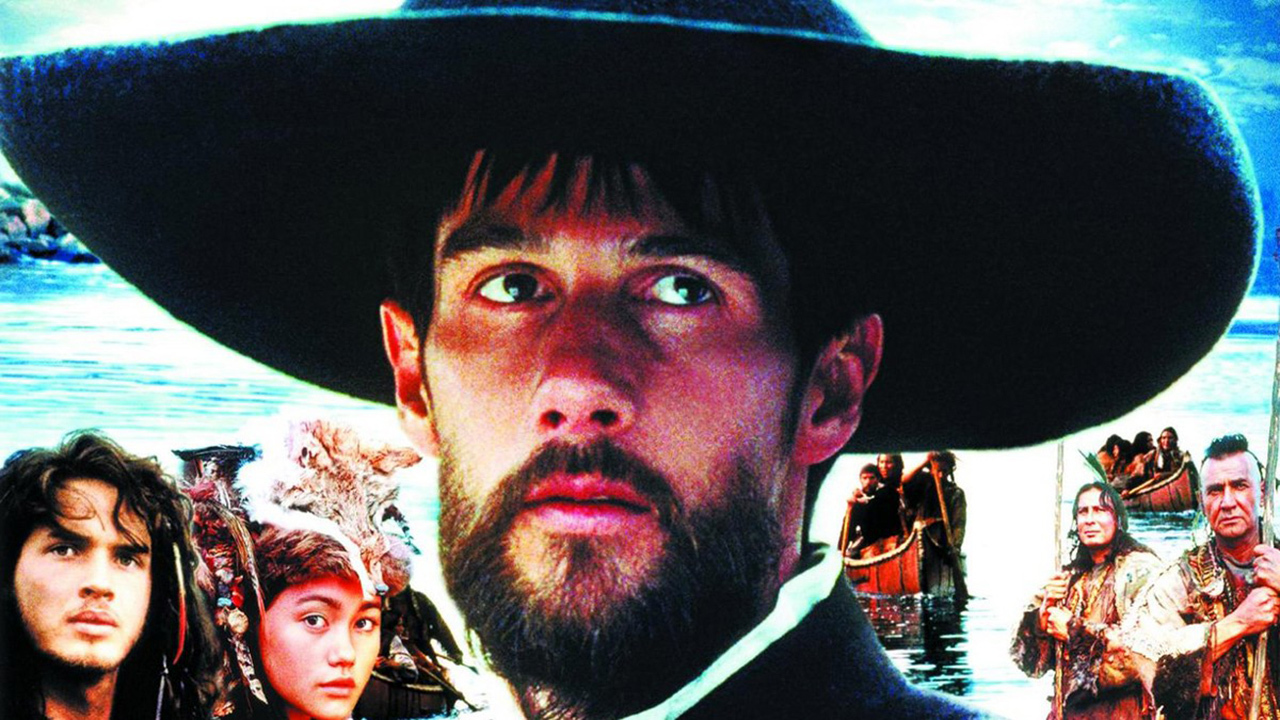
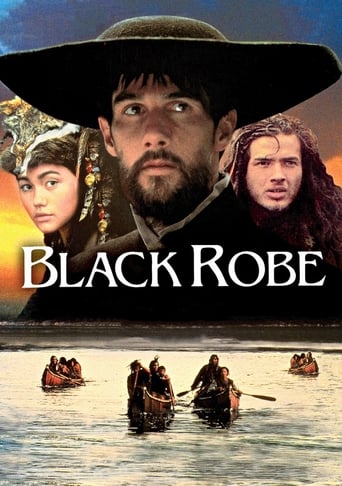
pc95 Preceding "Last of the Mohicans" but following "Dances with Wolves", Bruce Beresford's "Black Robe" seems to strike a neutral ground toward depicting Brian Moore's screenplay of a Jesuit on Mission bringing the Christian Faith to Huron Indians. Although I have not read the novel, the movie's cinematography, costuming, and settings are first rate to be sure. Vast landscapes of water, forests, trees, woodlands, and ice are on full display out in obvious location - there aren't too many sets. The story interestingly compares the supposed righteousness of one religion over another through dialog of characters though none seem to accept or appreciate the others religion, neither Indian nor Missionary. The acting was satisfactory, while the story is somewhat minimalist. Indeed the settings command the picture, and the movie is a worthy of watch because of them alone.
runamokprods If Bruce Beresford's 'Driving Miss Daisy' suffered from a softened, Hollywooden view of history and racial conflicts, the bleak, beautiful sometimes horrific, always uncompromising 'Black Robe' is its correlative opposite.Set in the 17th century, both the Native Canadian people, and the French Jesuits who come to bring then religion (when they already have their own, thank you very much) are presented as deeply flawed, cold and cruel at times, blind to the complexities of each other's humanity.Yet both are also touched by moments of kindness and understanding that lead to the sense that this story of one Jesuit's torturous trip with a band of native guides is not without it's growth for all involved.Most critics were mixed on this, and I understand their objections, though I don't share them. The film is distant emotionally, and we never really get inside any of the characters, even the titular priest, called 'Black Robe' by the native people. The film is more illustrative than dramatic. Again, the exact opposite strengths and weaknesses of Beresord's 'Driving Miss Daisy', which was full of wonderfully moving characters, but lacking honest context.But I found the historical context here, and intellectual insight, the suspense inherent to the story, along with the physical beauty of the locations and the sharply honest insight into the Native universe enough to be always engrossed and interested, and ultimately quite moved.
PWNYCNY Black Robe is a credible attempt to dramatize the clash of cultures in the early seventeenth century in what is today the region comprising northern New York State and Quebec, Canada. In this movie the principal characters: a Native chief, his wife and daughter, a French priest (the "Black Robe") and his companion, a young French man, are people caught up in a chain of events that highlight the similarities and differences, as well as the best and the worst features, of two cultural groups, one French and Catholic, the other Native American and non-Christian, as they take the first tentative steps in establishing contact. Remarkably, the two groups have much in common. Both have chiefs, both utilize similar rituals to strengthen group solidarity, both have warriors, both have priests, both have strong religious beliefs, both understood firearms, and both are inquisitive as to the nature of the other, including sexual, and are capable of interacting with each other on an intimate, including sexual level. Yet these similarities are far outweighed by their differences, such as in race, technological development, literacy, language and military power. For instance, in one scene, the French priest demonstrates writing to the Natives which the Natives find perplexing and disturbing. In another scene, the Natives are amused by a clock, which, though obviously important to the whites, to the Natives is little more than a silly noise-making contraption. Some aspects of the story are contrived, such as the affair between the priest's traveling companion (who, of course, is young, tall, sensitive and handsome) and the chief's daughter (who, of course, is young, lithe, passionate and beautiful, with a lovely countenance and a slight streak of rebelliousness, enhancing her charm), the gratuitous depictions of acts of copulation and close-up shots of horrible combat wounds, and the inclusion of "bad," that is, unruly and sadistic Natives, complete with scowling faces and menacing, mocking laughs, all clearly added for dramatic effect. These additions are pure Hollywood. Nevertheless, this movie succeeds as a work of art because of the presence of the main character, the "Black Robe." He is the bulwark of the story, the hub around which the movie revolves. This character is strong because he has moral integrity, that is, he is not a phony. He really cares about the Natives, as people and not just as targets for spiritual exploitation, and he knows that they are dying and wants to save them the only way he knows how; by bringing them salvation, unconditionally, through Christian faith, something which he really believes. The Natives sense that he cares about them, that he is not scheming to hurt them or steal from them, and are even comfortable enough with him to playfully poke fun at him, a sign of acceptance, and something they would not dare to do, or care to do, with most other white people, who they detest. Because if the Natives had hated him, they would have let him die or have murdered him, without hesitation, but they did not. When he was lost, they found him; when he was left in the forest, they went back to fetch him. By the end of movie, his acceptance by the Natives is complete as they come to him for spiritual comfort to ease the pain of their suffering. For "Black Robe," his mission is fulfilled; for the Natives it marks the beginning of a process of assimilation into a new culture that will soon lead to their cultural and physical decline, and for many, their extinction.Also, mention must be made of another principal character in this movie, Chomina, who fully grasps the predicament of his people and the implications of the white man's presence in what was once Native land. His character is symbolic of the best features of the Natives: strong, resolute, courageous, fair, honorable, fundamentally peaceful, uncorrupted, and above all humane, and his death represents the end of an era, which becomes even more apparent when his daughter decides to stay with her white boyfriend and not return to her people. Perhaps this interpretation of Chomina may seem a bit expansive, yet there were Native Americans who were known to embody these traits, so the character cannot be discounted as a mere cinematic contrivance.That this movie contains interesting and noble characters is commendable, yet what makes this movie worth watching is the substantive nature of the story itself which candidly addresses themes relevant to today's post-9/11 world in which the clash of cultures, under the banner "war on terrorism," has taken on global proportions.One other point: The clash of cultures depicted in this movie is part of a larger process of cultural decline and regeneration that occurs continuously throughout history everywhere in the world as cultures rise and fall and are replaced by other cultures. Languages that once flourished are now extinct; empires that once stretched across continents are long since gone. Understanding this makes the process more comprehensible but provides little solace for those experiencing the process, especially if it is their culture that is disappearing. One cannot help but be moved by the plight of the Native Americans as they realize that their way of life will be gone and that there is nothing they can do to stop it.The movie tells a compelling story about people from two cultural groups struggling to get to know each other and form social bounds under difficult circumstances and for that reason alone this movie is worth watching.
MacAindrais Black Robe (1991) Released with poor timing in the aftermath of a similar themed film - Kevin Costner's Dances with Wolves - Black Robe largely got lost in the shuffle. That's a shame, because the film is actually quite remarkable. Not to say that it hasn't had influence on other films however. Black Robe certainly must have had quite an influence on Terrence Malick and his The New World. The title credits are clearly inspired by those in Black Robe, and other aspects are familiar as well.Set in 17th century Quebec, the film follows a young Jesuit priest, Father Lafourgue (Bluteau), referred to as Black Robe by the natives. He travels with a band Algonquins lead by Chomina (Schellenberg). With Father Lafourgue is Daniel, a young Frenchman, who is in love with Chomina's daughter. The young priest soon begins to inspire fears that he is some sort of demon, and many in the band wish to leave him behind, or possibly even kill him and his companion.Their travels meet turmoil among other hostile native tribes, leading not only a struggle between peoples, but a struggle between faiths. Beresford creates a very bleak atmosphere, using the cold Quebec landscape as an intimidating, but still beautiful backdrop. The weather feels cold, the air crisp. It's really quite a beautiful film to look at.Bruce Moore, who wrote the screenplay and the novel it was based on, went to great lengths in research to accurately portray this period in time. Many have praised the film for its accuracies, while a number of others have however complained that it shows natives as savages. I have to disagree. Neither side is shown as total bad guys, nor total good guys. The film gives everyone a fair shake. Both sides have/had their reasons, and both sides committed terrible acts. Certainly, not all Natives were all about peace and love, which is not a slight to them in the least. Their history is a noble one, and they had every right to fear and be hostile in the face of Europeans. That said, I'm probably overcompensating for the film, because it really doesn't show Natives as savages at all, especially not the Algonquins. Moore claimed, in fact, that he actually toned down the violence of the Natives compared to what he found in his research. That said, what he found in his research was most likely overstated to begin with.Black Robe certainly is a bleak picture. The naturalistic photography and tone adds to the depressed atmosphere. This is not a story of joys, but of sorrows. When the film ends, we are told what history has already told us - the Natives were slaughtered and the Jesuit's mission by and large was a futile failure.Though the film sticks to its own dark history, this is more than just a very well done history lesson. Black Robe is a parable of the horrifying results that come from misunderstanding, miscommunication, and ignorance. While the Jesuit mission was well intentioned, it was more a product of Eurocentric ignorance than anything else. The Native people had their own religious beliefs, and the film shows that. The lessons in Black Robe are transferable to any number of modern day conflicts. We have not learned our lesson, and by removing the gloss and glamour off the period epics of old, Black Robe serves as a reminder. Such a shame its so overlooked.