Noutions Good movie, but best of all time? Hardly . . .
Salubfoto It's an amazing and heartbreaking story.
Sameer Callahan It really made me laugh, but for some moments I was tearing up because I could relate so much.
Billy Ollie Through painfully honest and emotional moments, the movie becomes irresistibly relatable
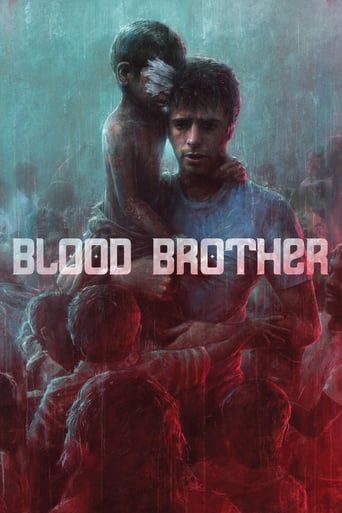
Murali Selvan Why do we watch movies ? Of course it's very subjective but yet when films become popular because of audience falling in love and giving a word of mouth, it does reflect a common denominator we all have as a fan. It reflects our taste, mind set or a collective mood.I wonder the same for this documentary. Amidst the various problems in the world from fatal diseases to terrorism to global warming, human have always fought and taken the civilization forward, generation after generation. To me this documentary is a triumph in many ways, it shows beautifully on a screen, by transporting one to the life of Rocky and rejuvenate your belief in humanity when it comes to helping others and showing compassion and love for fellow being that we share this earth with. Blood brother is an apt title if you ask me, as it opens your eyes that the boundaries we create - the walls we raise, the legal lines we draw means nothing at the end, when it comes to standing with a fellow human being in their dire need of suffering, help them stand again. We realize quickly that though we are not related, our hearts bleed when we hear people die in some remote part of the world, we feel and cry with the families when plane disappears, we show empathy when natural disaster hits and victims become our brother or sister. To me, the feeling of oneness is always there, deeply rooted in our genes and we are wired to protect and support each other. That is new law and new world.This film and story of Rocky, discovering his purpose in life is a beautiful reminder of that deeply rooted trait we all have that we are one.I applaud Steve and Rocky to present this as a film and I would highly recommend everyone to watch this.
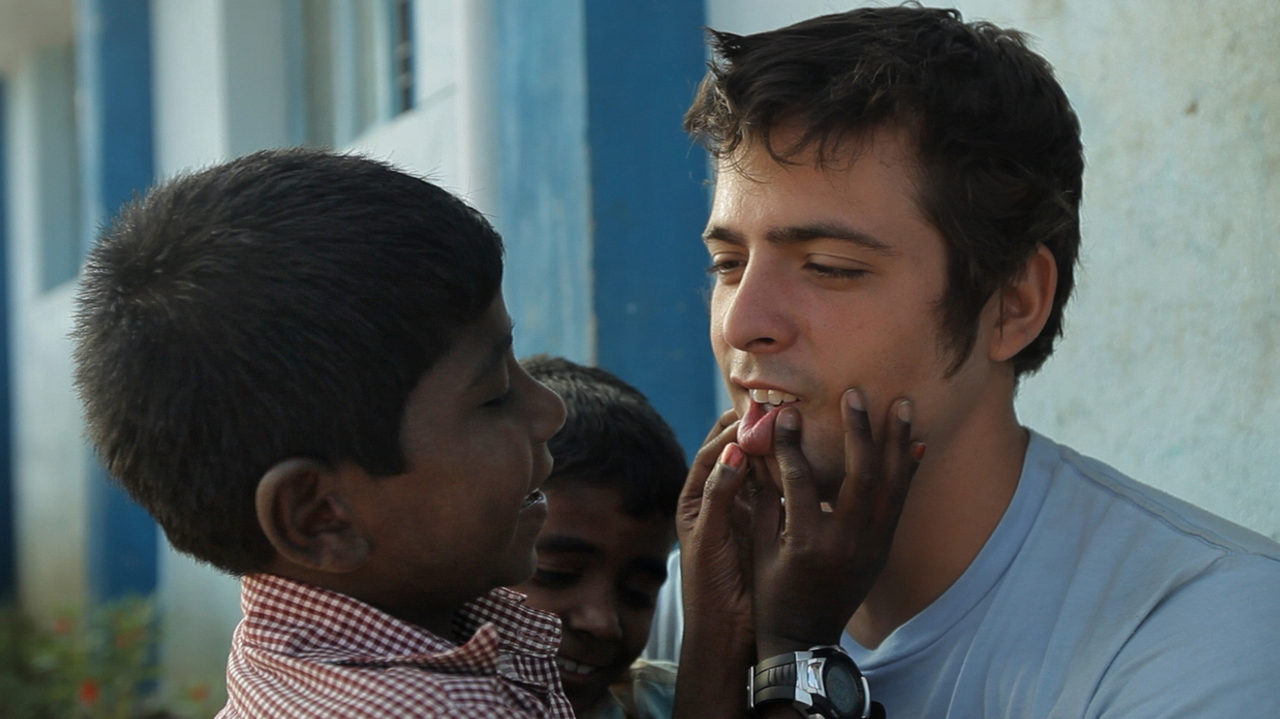
haondoor Blood brother is a documentary about Rocky, a young man who has been working in a AIDs center in India, and Steve, Rocky's best friend from childhood who currently lives in the United States, trip to an AIDs orphanage in India. The movie opens up with Steve picking Rocky up from the airport after his visa denied and having to return to the United States. Though it is evident that Rocky is not happy back home, but instead his heart and home is back in India. Soon Rocky's visa is approved, and he grabs the next flight out of the country, but this time Steve is close on his tail to discover what his best friends new life is like. In the course of Steve's filming he notices big changes in this overpopulated, third world country. Regular street laws are blurred and cleanliness and safety is not a worry of these people, but all of this does not stun Rocky instead he dives head first into this dangerous world. Along the journey Steve starts to gain Rocky's compassion for the AIDs infected children, and to focuses less on the horrible state of their country and more on each child's personality and how beautiful they are. Throughout the documentary Rocky constantly puts his health in the way to help the nurses, children, and village people, which in return love him for his ability to treat them with unconditional love. Much of the film has the audience swaying from happy while they participate in each birthday party, to devastated when the nurses and children became deathly sick in the snap of a finger. These shifts in emotions are potentially the most compelling parts of this movie because of the uncensored and real nature of world switchuations. These real moments take the viewer by surprise as they realize that what they are watching is not a dramatization but instead the real lives of children slowly die located on the other side of the same world. This notice of fine detail and emotions are in fact my favorite part for too many times do people want to take the scary reality out of public perspective because of it's impacts to the emotions of the viewers, but maybe those emotions are the needed ingredient to world change. Leaving the United States and heading to another part of the world has many barriers that a person has to overcome, and possible the biggest hurdle is the difference in the worldviews. In one of the scenes Rocky goes against the community belief, to keep a village girl home and just ask the spirits to heal her, to take her to a hospital. Though when things turn bad and the young girl dies the whole community blames Rocky because of his decision. This worldview found in the United States of the hospital being a place of rest and healing is contrasted by the people of India with their view of personal healing and enlightenment. Other situations increase the difference between the people Rocky knows as cultural family, and the people he knows as blood brothers. In the showing of "Blood Brothers" many quotes rise above the rest because of their ability to impact the first world population and connect us to the third world people he serves. One of these quotes said by Rocky, "I can't take any of them out of that situation, but I can put myself into it." forces us to contemplate our use of time, and if our impact is enough, but to Rocky he sees that "To live at home seems to be incredibly wasteful" and a heart change is necessary to impact the world in the same way Rocky does. The last two quotes that rise above the rest touch on the suffering of the people. "Other people can't turn off their suffering; they can't medicate their suffering with money." instead one must "realize that suffering is going to be normal part of my life" though Rocky has only spent a small time in India his impact is real and large, which challenges others to impact the world in their own places, way, and ability. In conclusion, I would consider watching this film for yourself not only because of the implications it leaves in your life after, but also because Rocky's life and experiences give a real and visual perception of what the world is like outside of one's personal comfort bubble. Appreciation forms for all those who serve and the understand that someone can play a small part in someone elses life. Though before watching ask these two questions: "Why would someone be compelled to leave the comforts of a life in the U.S. and go serve Indian children with HIV and AIDs?" and second "How would you feel if you were sent to an orphanage to work and take care of those children?" Both of these questions must be answered personally and honestly for it undercovers the true heart nature of your inner being. Personally, having gone to many countries on these same types of mission trips, and living in the best homes and the worst homes, I can say full heartedly that when a person sees the world and population through the eyes of God they cannot help but go. Something inside causes them to lose sleep at night and not be able to sit still because you understand that there are other people out there just like you in need of a simply relationship with God and a relationship with anyone else. It is difficult to think that all it takes is a little money and time to changed the lives of women, children, and the world, but when you see that Jesus gave his whole life for us, the least we can do is give our lives to Him!
lizkave ****WARNING **** SPOILER ALERT ****I was deeply moved by the acts performed by Rocky Bratt, the staff at the orphanage and the children who inhabit it while watching this movie. From what I could see many acts of generosity, selflessness and love contributed positively to the lives of the families within the orphanage.However, there were numerous instances during the viewing of this film when I was struck with unease regarding the portrayal of Bratt as selfless savior as well as the portrayal of the community where he worked. I also found some of Bratt's behavior to be professionally questionable. Below are some instances in the film that contributed to my unease.With regard to professional responsibility, I found the instances when Bratt and Hoover sought comfort from the children in the orphanage during their times of grief troubling. For example, when the young girl dies half way through the film, I found it inappropriate for Bratt to relay the details of her death and seek emotional support from a child living in the orphanage.Also, related to the girl's death mentioned above, both Hoover and Bratt express frustration that she was not taken to the hospital before becoming mortally ill. No discussion regarding the subjects of poverty, access to health care, lack of education or skepticism of institutions were suggested as possible barriers to her family seeking medical care. What was portrayed was that the community's faith and social practices alone prevented a visit to the hospital. Considering that Bratt had decided to marry into the community portrayed in this film, I would have thought some research into the daily circumstances of the inhabitants warranted.Finally, at no point are people from the community interviewed about their lives, beliefs and practices. Bratt mentioned that the community was outraged to find out that the orphanage cared for children and families living with HIV. I also got the impression that Bratt disapproved of the community's response. As a health care worker I am well aware of the stigma, fear and misconceptions often linked to HIV and AIDS in almost all cultural settings. I would have thought someone working within the HIV community would have been aware of these social barriers and would have done some legwork within the community regarding.In conclusion, Blood Brothers is an evocative portrait of one man's struggle to find his place in the world. Unfortunately, it's portrayal of the the international medical relief work performed by this man is lacking in depth and analysis. As such, I did respond emotionally to the powerful acts of kindness performed by the protagonist and others in the film. However, the element of transparency in documentary film making was seriously lacking. This left the viewer and even those in the film to project their own ideas and beliefs on a society left unexplained. I do believe this discrepancy may be a result of the predominantly faith based perspective of the filmmakers. Acts of God (such as Bratt's love / devotional work?) are rarely expected to be proved or explained as effective catalysts of change, only accepted. Acts of God certainly won't address the deep seated problems of poverty and stigma that will continue to subject HIV orphans in India to discrimination. The consequence of which is most often a lack of or withholding of much needed social services.
Eric Carr At the our screening of Blood Brother at the Sundance Film Festival, the filmmakers had to ask the audience to stop our standing ovation. As a host for Sundance Film-Forward and the Human Rights Watch Film Festivals, I've seen hundreds of docs, and Blood Brother is far-and-away the best documentary our group had seen in years, and the best film we saw at Sundance this year - period. The film doesn't just have heart, either, but is full of stunningly beautiful cinematography with scenes that make the filmmakers seem impossibly lucky. The film swells with emotive music, inspired events, unscripted words of incredible wisdom, and moments of raw transparency. In the end, it becomes a film that transcends its genre. At its core, Blood Brother is a universally appealing film, which I believe is one of the reasons it was such a rousing success at Sundance. It is a buddy film, a hero's journey, a drama, a comedy, and a love story all rolled into one epic documentary that reminds the viewer just how beautiful and valuable even the most tragic of lives can be. After the film, Rocky (the subject of the film) and the film crew hung around to answer questions, and it was clear that the film was an honest and genuine glimpse into the lives of extraordinarily compassionate people who truly live up to the radical kindness expressed in the film. It certainly deserves every accolade it has garnered so far.