Listonixio Fresh and Exciting
Stevecorp Don't listen to the negative reviews
ShangLuda Admirable film.
Kien Navarro Exactly the movie you think it is, but not the movie you want it to be.
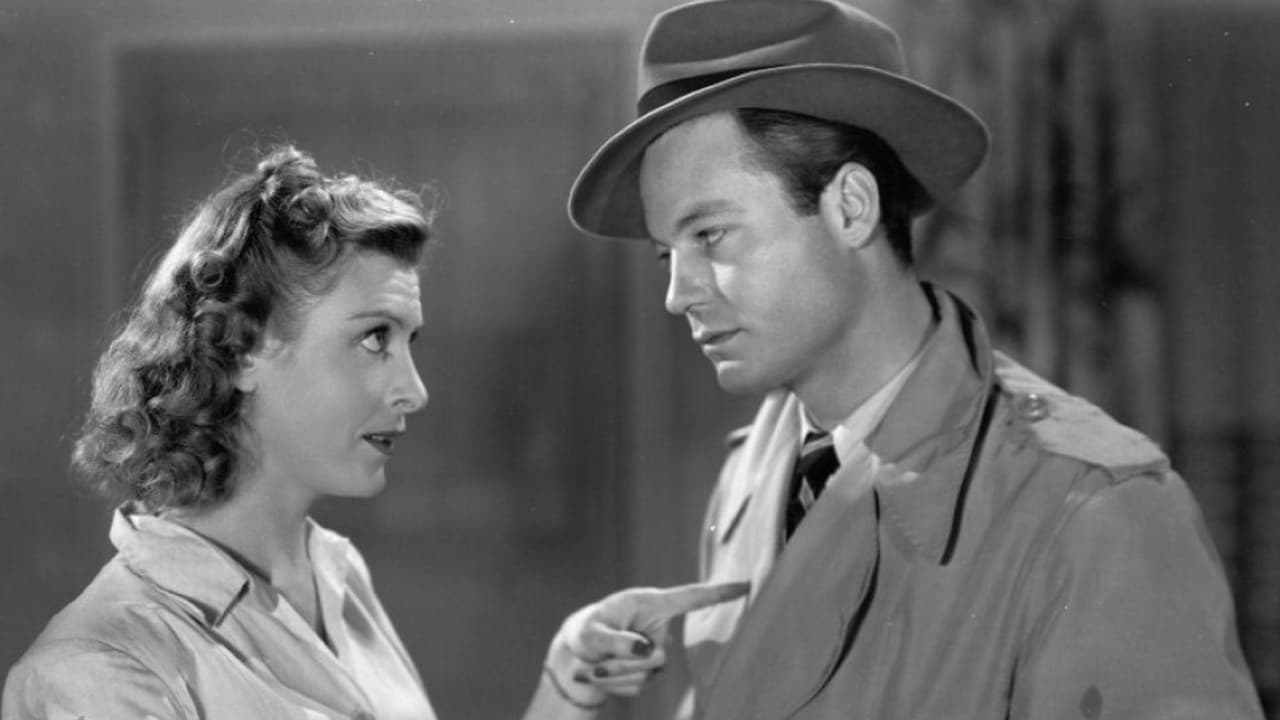
st-shot Bank teller Vince Grayson (DeForest Kelly) wakes from a murderous nightmare that seems all too real with concrete evidence that it may well be true. Unable to shake the images from his mind his behavior at work becomes suspect as he irrationally bolts the job seeking to settle his confusion. He turns to his brother in law Cliff Herlihy (Paul Kelly) for help but even he has his suspicions.With it's intriguing nebulous opening Fear in the Night makes a decent effort at working noir tropes that evoke The Lady from Shanghai, DOA as well as masque the case building against Grayson well into the story. Even Grayson begins to believe he may be guilty and attempts suicide.As the confused Grayson, DeForest Kelly is an everyday benign working slob that in most circumstances seems harmless but director Max Shane saddles him with damning doubt early and Shane plays the character and the evidence to sustain suspense well into the film. Paul Kelly's cop brings balance to the story with his just the facts sobriety contrasting Grayson's free fall and incertitude. Left up to Grayson, he'd fry so it is left to Herlihy to advance the film.Jack Greenhalgh's cinematography remains strong most of the way after a bravura opening of strong expressionistic imagery that sets the stage. But overall the supporting cast remains weak and the shoestring budget glaring at times before a far-fetched denouement waters down matters even further. Still the artistry in this cheapskate makes it an interesting watch.
JohnHowardReid Writer-director Maxwell Shane remade the film in 1956 as Nightmare starring Kevin McCarthy as the impressionable young man and Edward G. Robinson as his strong-willed brother-in-law.This was Kelley's feature film debut. He'd previously appeared in a small role in a 1945 short variously titled The Letter and Time To Kill starring George Reeves, Barry Nelson, Don Hanmer, Jimmy Lydon and Don Taylor. Although the re-make with Edgar G. Robinson has a bit more clout in the acting department, this one features a marvelous performance by Robert Emmett Keane, stepping out of character for once as a pest of a neighbor. True, Kelley's portrayal is little too overdone. The schmuck is supposed to be weak-willed but Kelley turns him into such a nerve-racked fraidy-cat that he tends to lose audience sympathy. Paul Kelly, of course, is well cast as the detective, and, aside from Kelley, he receives excellent support all the way down the line. Although the film was lensed on a "B" budget by the two dollar Bills, it seems to have more production values than the usual Pine-Thomas bills of fare.
Robert J. Maxwell Spoilers.DeForrest Kelley narrates the opening and, intermittently, much of the rest of the story. He begins with something like, "A glowing face seemed to come towards me out of the darkness." On the screen, we see a glowing face seem to come towards us out of the darkness. A bit later the narrator tells us, "The room began spinning." On the screen, the room begins spinning. I guess the director, Maxwell Shane, must have given up at about the point at which the narrator tells us, "My heart was beating like a jackhammer." There isn't an abundance of imagination on display in this rather interesting story of an innocent nobody who is hypnotized into taking part in a burglary during which he's forced to kill a man. He wakes up the next morning believing it to have been a nightmare, except that there are some strange objects in his pockets and a smear of blood on his wrist. He explains his unease to his brother-in-law who is an officer in the homicide department. That would be Paul Kelly. Kelly dismisses it irritably and tells Kelley to pull himself together. But Kelley is unable to do that and fills the rest of the film with the pungent odor of sweaty fear. This was his film debut and he's neither good nor bad, just another actor with ordinary talent. You could probably find someone at about his level in any play, maybe "Our Town," produced at a community college in some sleepy town somewhere in Arkansas.The story is from Cornell Woolrich, a strange guy -- homosexual, boozer, recluse, and amputee. He wrote a lot of pulp stuff that was adapted into radio plays and films -- "Rear Window," "The Bride Wore Black." Well, it's a living, or at least it was when people still read books. He may have been the equal of James M. Cain when it came to prose style, in the sense that neither had any. Reading either of them will remind you of reading a newspaper. Raymond Chandler at least tried for some insane poetry, no matter how idiosyncratic it was. You know Chandler's oft-parodied line: "Her hair was the color of gold in old paintings"? You won't find anything resembling that in Cornell Woolrich or in this adaptation.The budget must have been very low. Aside from Paul Kelly, there are only one or two recognizable faces, such as Charles Victor's and Ann Doran's. There is little outdoor shooting. The sets are mostly skimpy. But the director sometimes goes ape over on-screen effects. The ancient iris is replaced by an expanding star, for instance. And the nightmare sequences -- wow. By the way, this guy's nightmares make a lot more sense than mine do. No glowing faces seem to come towards me out of the darkness. Aside from the sex elements, which I don't mind as long as they don't involve those funny animals, they often seem to involve my running away from some horrifying manticore or something, intent on eating me alive, while I try to flail my way through a vast swamp of molasses. I'm told that dreams of appearing naked in public are common but I've never been bothered by them, and as far as this movie goes, I'd prefer seeing DeForrest Kelley stabbing someone with an awl to watching him run through Port Authority with no clothes on. In fact, that's a pretty disgusting image.The musical score is perfunctory and the direction is functional, no more than that, with one or two exceptions. Here's one of them. Kelley calls in sick and his teller's window at the bank is filled by the young lady who loves him. The director shows her replacing his name plate with hers at the window and for a moment she holds the two names side by side and smiles down at them. It's a small moment but someone had to think of it. More like it would have helped.The element of hypnosis is not new but still fascinating because, even now, no one knows exactly what's going on in the hypnotic state. I studied the subject in graduate school and I've used it as an adjunct to therapy and it works fine in certain limited contexts. But it remains a mystery. Surgery has been performed using no anesthetic other than hypnosis. What we see of hypnosis on the screen is possible, but barely.
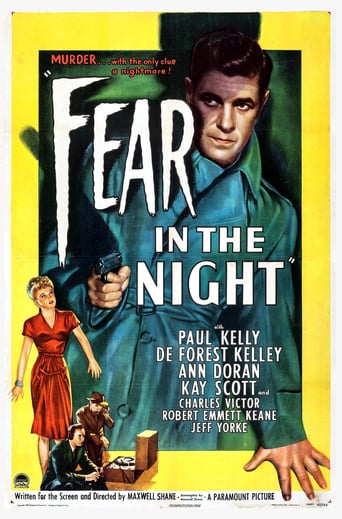
Spikeopath Fear in the Night is directed by Maxwell Shane who also adapts from Cornell Woolrich's (AKA: William Irish) story titled Nightmare. It stars Paul Kelly, DeForest Kelley, Ann Doran, Kay Scott & Robert Emmett Keane. Music is by Rudy Schrager and photography Jack Greenhalgh. Plot finds bank teller Vince Grayson (Kelley) awoken from a nightmare where he kills a man in a mirrored room. Disorientated and sweaty, Grayson is further startled to find bruises on his neck and items about him that suggest that his nightmare was real. After confiding about the events to his brother-in-law, detective Cliff Herlihy (Kelly), it's presumed he's under stress and a good day out with the girls will do him wonders. But once the picnic with the girls is interrupted by a storm, Grayson finds himself leading the group to a house in the country. A house he doesn't know and a house he's sure he's never been to, but upon the discovery of a mirrored room it becomes evident that something very strange is going on
.Low budget across the board but not suffering too much for it. A cracking little film noir mystery neatly condensed into 72 minutes. Maxwell Shane's film is dealing in dreams and a protagonist caught in a circumstance, without understanding, that's out of his control. Tormented not only by the events of what appears to be in his "dream", but also by the heavy cloud of befuddlement that follows him during daylight hours. He himself ponders if he is going insane? It's a good question, and one which Shane and Woolrich do well to not answer for the first half of the film as the atmosphere stays hazy. The tone of the narrative is aided considerably by Greenhalgh's photography, Schrager's music and Shane's box of cheap, but hugely effective, tricks.Much of the film relies on visuals to make its points, even as we get a cool pulpy voice over from Grayson, the blurry shifting images say much more. So too does the use of mirrors, very Hitchcockian: with the actual mirrored room at the core of the story very disambiguation like. There are shadows involved for practically every interior shot and even for much of the outdoor sequences too. While the music comes from the realm of the haunted house. The cast give variable performances, but there's nothing to hurt such a short movie. Lets just say that Kelley (in his first main role) fits the dazed requisite well and it's no bad thing that Doran & Scott don't get a lot of screen time. Kelly (Crossfire) is good value, making a believable copper, while Keane is wonderfully sedate and creepy (check out the candle sequence).True enough there's problems that stop it being a B noir classic, such as the back screen shots and the afore mentioned less than stellar acting. Whilst the film would have benefited more by having a Gothic designed house as opposed to the white picket fence type that is used. But considering the budget and time of its making, it's an admirable film that's easily recommended to noir and murder mystery fans. Shane liked the story enough to remake it as Nightmare in 1956 with Edward G. Robinson & Kevin McCarthy as cop and protagonist respectively. A bigger budget and name actors it has, but the jury is still out on its worth. I'm happy with this version, thanks, even if the DVD print is old and scratchy. 7.5/10