BootDigest Such a frustrating disappointment
Odelecol Pretty good movie overall. First half was nothing special but it got better as it went along.
Numerootno A story that's too fascinating to pass by...
Erica Derrick By the time the dramatic fireworks start popping off, each one feels earned.
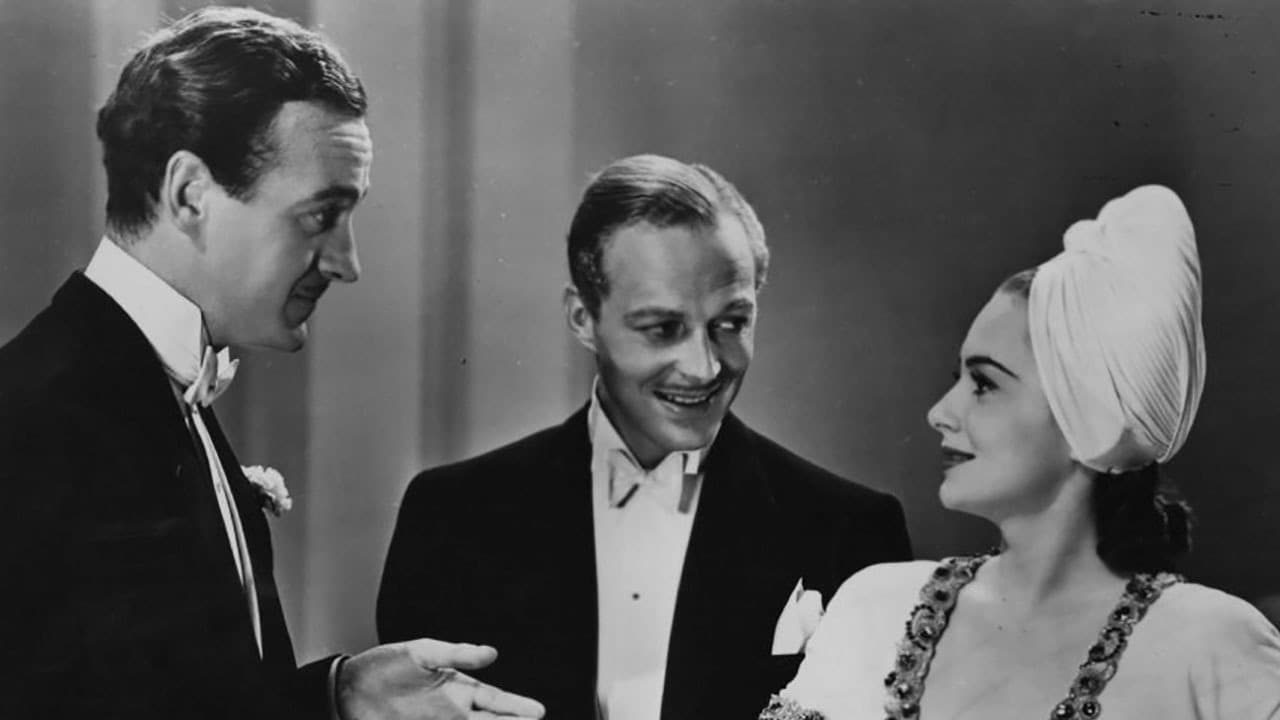
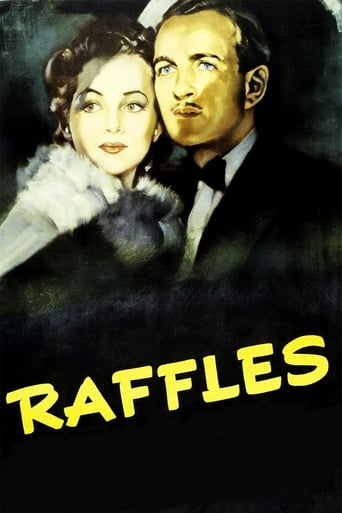
SimonJack This second sound film of E.W. Hornung's gentleman thief, A.J. Raffles, follows the 1930 film that starred Ronald Colman and Kay Francis. Samuel Goldwyn produced both films, just nine years apart. So, he must have wanted to try a better, more thorough screenplay, or try an entirely different cast. Or, judging from this film, it was a little of both and maybe some other aspects. This "Raffles" is a better production with a tight, well-written screenplay. It doesn't have the holes that the early version had. It has some characters developed more and others less. As with the first film, all the actors are fine. But two stand out here – Olivia de Havilland as Gwen and E.E. Clive as Barraclough. Both have meatier roles and some very good lines. On the other hand, the Lord and Lady Melrose characters are much toned down in this version compared to the 1930 film. It's not bad, but they miss some good lines between them. Dudley Digges as MacKenzie is more prominent as a thinking detective here, whereas David Torrence was more cock sure of himself and funny in a boastful way. David Niven is OK as Raffles, but I would like to have seen Ronald Colman reprise his role in this film. With his extra sprightliness in the role, A.J. Raffles would have seemed more the daring burglar than does Niven. And, I think Colman and de Havilland would have made a more striking couple. Still this film for its screenplay and quality is a notch above the 1930 version. And, there is one thing in this movie that adds historical value to it. It would have stood out to audiences at the end of 1939 more than anything else. Most people watching this decades later don't notice or give it a thought. But it would have been a huge surprise to audiences then. And that's the TV set in the movie. In an early scene, the chief of Scotland Yard turns on a console television set that is broadcasting a cricket match in London. This was at a time when TV was hardly known anywhere in the world. The acronym, TV, was not yet a household word.Sure, people would have heard and read about development of moving pictures that could be sent over the airwaves. They would have read the news about experimental TV stations in the early 1930s. TV was being researched and developed in England, Germany and the U.S. But it was greatly slowed down by the worldwide Great Depression (1929- 1941). In 1928, a company in New York sent the first TV images over the air. In 1936, the BBC began broadcasting from its first station at Victoria Alexandra Palace in the north of London. Germany broadcast the 1936 Summer Olympic games to 28 public television rooms in Berlin and Hamburg. And TV broadcast Pres. Franklin Roosevelt opening the New York World's Fair in 1939. And after this film, TV would be further delayed by World War II. At the end of 1939, when this movie came out, there were no more than 5,000 TV sets in the U.S., and far fewer in England. Most of those were located in bars and hotel lobbies. More than two-thirds were in New York. In 1946, after the war, there still were only six TV stations in the entire U.S. Three were in New York City, and one each was in Chicago, Philadelphia and Schenectady, NY. So, if what we see in this film is an actual TV, it must be the very first movie made that shows a television set. And, it's not just any set. It's a deluxe, large screen model. It looks to be 17 to 20 inches. The first one my family had – in 1949, was a 9-inch screen. If this movie was made at the MGM studios in Hollywood, Goldwyn may have acquired one of the first TV sets in the Los Angeles area. But it's not very likely that the cricket match had really been shown on TV. It probably was the replay of a film of a cricket match, reduced to fit and appear inside the TV console. I doubt that there would have been a cricket match broadcast in London over TV in 1939, but there may have been. If so, Scotland Yard would have had one of the very first TV sets in England. Here are some favorite lines in this film. For more humorous dialog, see the Quotes section under this IMDb Web page on the movie. Raffles, "Tell me, Barraclough, why have you never been married? Surely there must have been some woman in your life." Barraclough, "There was. Two of them, to be exact. Twenty-three years ago." Raffles, "And neither of them became Mrs. Barraclough?" Barraclough, "No sir. Perhaps that was because I knew them both at the same time, sir. It didn't seem to work out." Raffles, "Barraclough, did I remember to tell you she's the most wonderful girl in all the world?" Barraclough, "I had hoped, sir, that you were going to spare me that. Good night."MacKenzie, "It's not the first time I've sent a thief to catch a thief."Lord Melrose, "My dear, you know I don't like music." Lady Melrose, "And I don't like cricket. But I don't take a nap in the middle of the playing field."
Luis Guillermo Cardona Do not know about you but as far as I am concerned, since a child I loved that movie heroes were marginal and risky to steal from the rich and give to the poor. The bank robbers, who without firing a shot-safes to leave the applause encouraged me, and anyone who exposed their lives to bring dignity to the people, deserved a good place on the corner of my heart grateful. Robin Hood was the prototype, and then met the Crimson Pirate the Captain Blood... up to this trendy Raffles who, besides being a famous cricketer, occasionally steals in an art gallery, in an ostentatious jewelry or steals any aristocratic lady a necklace, then, does one need to return, so, so, it will pay the reward. That is, a thief returner. Steal with elegance, but pretend. And what we love about Raffles is that it is a handsome, elegant, well spoken, courteous and able to get along great even with the hound that pursues him ready to catch it as a good salmon. Meanwhile, love and ends up making her an accomplice to the same woman who, one day, also get into the heart of Hood and even the same Blood
¿Do you can believe it? Well, I'll explain in case anyone is not up to date: David Niven ago Raffles "The thief cracksman" as he signs his messages of farewell. And Olivia de Havilland, the love with Erroll Flynn in "The Adventures of Robin Hood" and "Captain Blood", is now Gwen, the girl who wins back the heart of the hero of the day. And that is how: beauty, sweetness, consistency and accessibility. A donut with whipped cream. The film is charming, curious tricks, sharpness of wit and some other really funny situation. The story catches without difficulty and you feel quite at ease with a handful of delightful characters. Believe me, is a detective film... and there's no bad, almost everyone is honest. No for nothing, the same story was made into a movie-in just 23 years-in four successful cases.
blanche-2 "Raffles" seems like it was a quickie - it doesn't last very long and it has an abrupt ending. Nevertheless, "Raffles" features two dazzling stars - David Niven, well-cast as an upper class thief, and Olivia de Havilland as the beautiful object of his affections.One interesting thing about this film - which made me realize that I had seen it years before - is the early television in the inspector's office at the beginning of the movie.I regret not seeing the Ronald Colman version. In this one, Niven is charming, handsome, and debonair as a man who seems to steal as a lark and then somehow returns the merchandise, to the frustration of the police. At the film's start, he steals a valuable painting, sends it to his favorite retired actress, and has her return it for the reward money. But when he tries to steal a necklace to help a friend replace money he gambled away before an audit takes place, he runs into another crook attempting to do the same thing, and complications arise.There are some suspenseful moments toward the end of the movie, but all in all, it goes by too quickly, and the character of Raffles isn't sufficiently developed. It's almost as if the movie starts in the middle and ends before it's really over. De Havilland is absolutely beautiful, even if a couple of her hats are outrageous. She's really just doing an average ingénue role here. "Raffles" debuted in the U.S. just before "Gone With the Wind," and she probably made it right afterward.Entertaining but disappointing.
Neil Doyle RAFFLES ('40) contains a charming performance by David Niven as the jewel thief who constantly eludes detection by Scotland Yard. Niven has an equally charming co-star in Olivia de Havilland as his sweetheart--a thankless role which gives the actress a strictly cardboard leading lady role. It's Niven and the large supporting cast that consume most of the footage as the plot thickens and a Scotland Yard detective is hot on his heels.Slow paced, only mildly entertaining, this one offers nothing in the way of wit or excitement to stir up anything more than moderate interest. Fans of David Niven and Olivia de Havilland get a chance to see the photogenic pair at their physical peak--but that's not enough to sustain interest in this bland remake of the earlier Ronald Colman version.A standout in the largely British supporting cast is Dame May Witty as Lady Melrose whose necklace has fascination for the amateur thief.Trivia note: Interesting to see a film from 1939 that shows a sports program being televised clearly on a rather medium-sized TV screen...long before TV became a household staple in the late '40s and early '50s.