Exoticalot People are voting emotionally.
Rijndri Load of rubbish!!
Pluskylang Great Film overall
Brendon Jones It’s fine. It's literally the definition of a fine movie. You’ve seen it before, you know every beat and outcome before the characters even do. Only question is how much escapism you’re looking for.
duif_holmes This movie had some good ideas, as others have pointed out, but the people behind it didn't really seem to understand the difference between plays and movies. Plays are "allowed" to be a bit talkier than movies since the actors doing the talking are in the same space breathing the same air as the audience. On the other hand scene breaks and multiple short scenes aren't nearly as disruptive in movies as in plays, so for God's sake use them! For example, after the opening shot of the printing press we never see the place again. Result: we don't care about it nearly as much as the characters do.Also, the "villain" of the piece does some emotionally abusive stuff off screen, but the "hero" is a bit of a jerk on screen. Result: while watching the movie I ended up rooting for the wrong person at the end.And this is probably more of a writing and acting problem than a cinematography problem but the relationships are so underdeveloped that Cecelia and Daisy running off together would almost make as much sense as what actually happens.All in all, this movie is ripe for a remake by someone who actually knows what a movie is. And since it's in the public domain pretty much anyone can take a shot at it. Otherwise just read the plot summery off Wikipedia. It has all the interesting twists without any static talking scenes.
dougdoepke A movie like this strikes me as a matter of taste. On one hand, it's slow, talky, and confined strictly to drawing rooms. On the other, it's a story of some substance, as Tom (Howard) must work through common human desires to figure out where happiness lies. In short, should he link up with the sexy Cecilia (Loy) or with the talented Daisy (Harding). Had the screenplay tightened up, varied the staging, and livened things up, the appeal would be stronger. Unfortunately, the lively butler's (Gargan) un-butler antics don't amount to much bouncy relief. Nonetheless, Loy is drop-dead beautiful and a convincing manipulator, while Harding settles for a secondary and less glamorous role. I still can't decide on Howard—is he miscast or not. On one hand, he's got a bland screen presence, one that works against the pacing. Then too, I'm afraid a livelier mood would have overwhelmed his restrained struggle. On the other hand, he manages considerable subtlety in his portrayal of the conflicted rich man's son. Overall, viewers not turned off by what amounts to a filmed stage play, may find subtle rewards in this searching 85-minutes. For me, it was mainly a disappointing struggle.
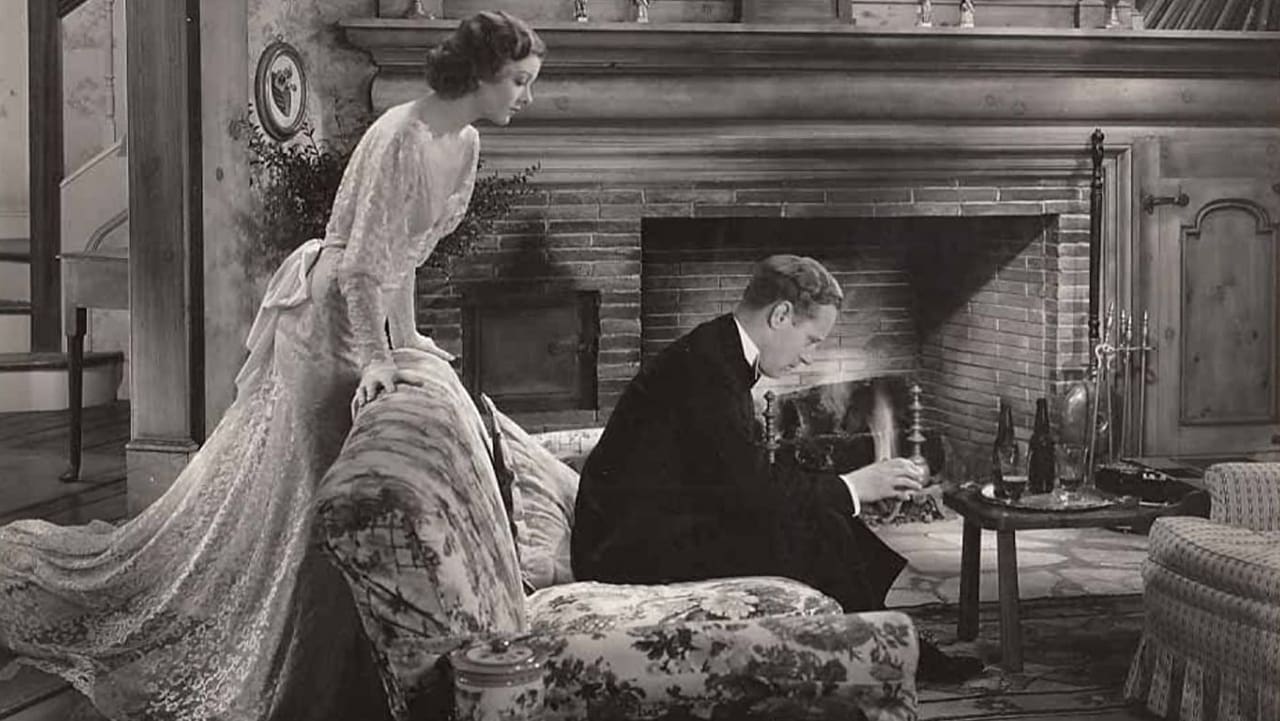
wes-connors After his engagement to alluring socialite Myrna Loy (as Cecilia Henry), Connecticut publisher Leslie Howard (as Tom Collier) learns former friend and lover, artist Ann Harding (as Daisy Sage), is returning to an apartment they shared. Professing her undying love, Ms. Harding startles Mr. Howard by proposing he marry her, instead; and, as Harding notes, she is accepting Howard's numerous past proposals. Howard is conflicted, but chooses to marry Ms. Loy. Yet, Howard can't forget Harding - does he love Loy, Harding, or both? "The Animal Kingdom" is a sleepy, spineless version of Philip Barry's stage play - but, it has a good cast.**** The Animal Kingdom (12/23/32) Edward H. Griffith ~ Leslie Howard, Ann Harding, Myrna Loy, William Gargan
jaykay-10 This is a plodding drama, devoid of the sparkle and cleverness that mark some of Philip Barry's work. In fact, Barry repeatedly utilizes not only the same social milieu, but an almost identical set of character types involved in familiar kinds of relationships. If you've seen one Barry play (or screen adaptation), you've pretty much seen them all. Try "The Philadelphia Story" or "Holiday" in place of "The Animal Kingdom." In those, you will not have to wonder why the characters are, or are, not drawn to one another. Leslie Howard does his level best with a less-than-fully-conceived character whose social and family obligations appear to be in conflict with his need to maintain his integrity, and his potential for achieving personal happiness. It is stolid Ann Harding who is all wrong, barely registering emotion as a supposedly free spirit who can rescue her lover from the dull existence that awaits him without her.For a far more effective handling of a similar story and characters (not created by Philip Barry), watch "H.M. Pulham, Esq." with Robert Young and Hedy Lamarr.