Grimerlana Plenty to Like, Plenty to Dislike
Acensbart Excellent but underrated film
Odelecol Pretty good movie overall. First half was nothing special but it got better as it went along.
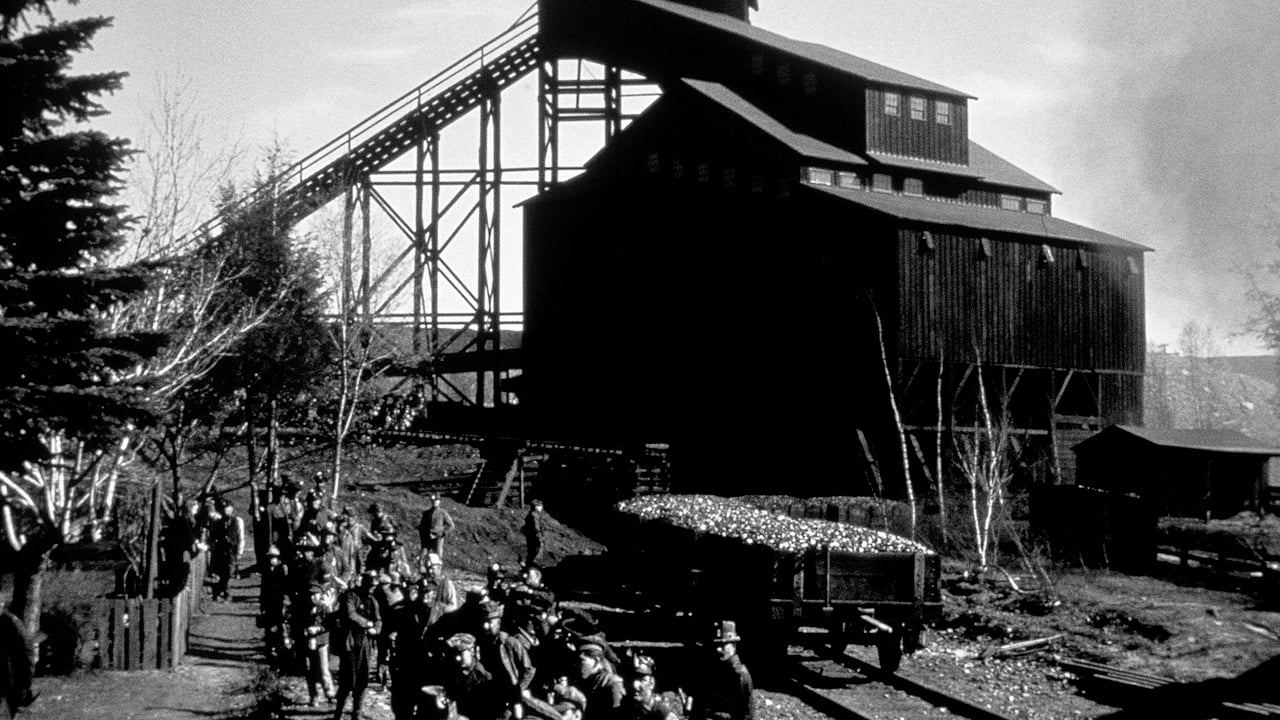
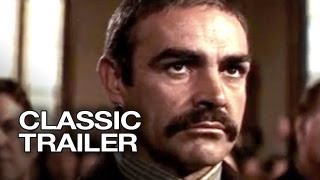
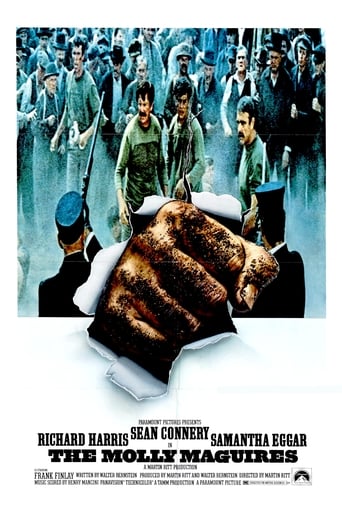
ma-cortes Real story about secret society of Irish miners in Pennsylvania , circa 1876 .The Molly Maguires was an Irish 19th century secret society active in Ireland, Liverpool and United States. The "Mollies" were mostly known for their activism amongst Irish American coal miners in Pennsylvania , they fought for better conditions for coal miners , using even terrorist acts . The Molly Maguires" were so-called because they would often disguise themselves by wearing womens' clothing, hence their name . Life is rough in the coal mines of Pennsylvania , suffering a dreadful existence . Wages were low, working conditions were atrocious, and deaths and serious injuries numbered in the hundreds each year. As the film deals with a secret group of Irish immigrant miners, known as the Molly Maguires led by a worker (Scotsman Sean Connery as Jack Kehoe who was not a miner, but the owner of a saloon, The Hibernia House) , there arrives a newcomer (first-rate performance by Irishman Richard Harris) who is working as informer , in fact , he is a Pinkerton detective who infiltrates the group .Exciting and thought-provoking story of Unions , treason and secret societies plenty of interesting drama , emotion and a strong antagonism between entrepreneurs and mine-workers . This good flick packs nice acting , vivid settings , evocative atmosphere , though is hurt by overlong scenes and depressing finale . Interesting screenplay dealing with brooding themes such as betrayal , fidelity , working fight , terrorism and many other things . As main cast : Connery , Harris , Eggar , as support cast : Frank Finlay , Anthony Zerbe , John Alderson , Bethel Leslie , Art Lund , Anthony Costello give top-notch interpretations . Colorful cinematography in Panavision by the classic cameraman James Wong Howe , filmed on location . According to cinematographer Howe, director Martin Ritt wanted to photograph this film in black and white, but was not allowed to do so by Paramount . Most of this film was shot in Eckley, Pennsylvania ; Paramount Pictures saved the town from being destroyed , it was slated to be demolished for strip mining . Special mention to impressive musical score , including a breathtaking leitmotif .This understatement as well as downbeat motion picture was compellingly produced and directed by Martin Ritt , though a little long . The film was a notorious flop when it was released in 1970, earning back a little over 10% of its $11-million budget, an enormous sum for the time . Director Ritt blamed the film's massive critical and commercial failure for permanently damaging his career. Ritt was an expert on well-crafted dramas such as ¨Stanley and Iris¨ , ¨Nut¨ , ¨Norma Rae¨ , ¨The front¨, ¨The Sound and the Fury¨ , ¨Black orchid¨ , though also directed films of all kind of genres such as : ¨The Spy Who Came in from the Cold¨ , ¨The Great White Hope¨ , ¨Mafia¨ . And he worked with Paul Newman in three Westerns : ¨Hombre¨ , ¨Hud¨ and ¨Outrage¨. ¨Molly McGuire¨ film will appeal to drama enthusiasts and Sean Connery , Richard Harris fans . Rating : Above average, well worth checking out ; along with ¨Outrage¨ , being one of Ritt's best movie.The picture was well based on actual events , they are the followings : About 22,000 coal miners worked in Schuylkill County, Pennsylvania. 5,500 of these were children between the ages of seven and sixteen years, who earned between one and three dollars a week separating slate from the coal. Injured miners, or those too old to work at the face, were assigned to picking slate at the "breakers" where the coal was crushed into a manageable size. The miners lived a life of "bitter, terrible struggle". Wages were low, working conditions were atrocious, and deaths and serious injuries numbered in the hundreds each year. The mine owners without one single exception had refused over the years to install emergency exits, ventilating and pumping systems, or to make provision for sound scaffolding and on September 6, 1869, a fire took the lives of 110 coal miners. Franklin B. Gowen, the president of the Philadelphia and Reading Railroad, and of the Philadelphia and Reading Coal and Iron Company and "the wealthiest anthracite coal mine owner in the world", hired Allan Pinkerton's services to deal with the Mollies. Pinkerton selected James McParland to go undercover against the Mollies. Using the alias "James McKenna", he made Shenandoah his headquarters and claimed to have became a trusted member of the organization.McParland's assignment was to collect evidence of murder plots and intrigue, passing this information along to his Pinkerton manager. He also began working secretly with a Pinkerton agent assigned to the Coal and Iron Police for the purpose of coordinating the eventual arrest and prosecution of members of the Molly Maguires. After months of little progress, McParlan reported some plans by the "inner circle". When Gowen first hired the Pinkerton agency, he had claimed the Molly Maguires were so powerful they had made capital and labor "their puppets". When the trials of the alleged puppet-masters opened, Gowen had himself appointed as special prosecutor . On June 21, 1877, six men were hanged in prison .
tieman64 "Power concedes nothing without a demand. It never did and it never will." - Frederick DouglassLoosely affiliated with radical leftists, director Martin Ritt spent several years under a Hollywood blacklist. When McCarthyism died down, and directorial reigns were returned to him, Ritt made a series of socially conscious films, most of which were about struggles for equality, or which portrayed the downtrodden in a sympathetic light.In this regard, Ritt's "The Molly Maguires" stars Sean Connery as Jack Kehoe, the leader of a secret organisation of Irish miners who seek better pay from their corporate employers during the late 1800s. Ritt has made such "pro-unionist" films before – see "Norma Rae" - but "The Molly Maguires" shoots off in unique directions. Here the Mollies use terroristic tactics to destroy factories, equipment and even people. This leads to Pinkerton Detective James McParlan (Richard Harris) going undercover and infiltrating the group. From here on, the film morphs into a gangster flick or undercover cop show, McParlan attempting to subvert the Mollies from within.Today, whilst violence reigns across capitalism's peripheries, the system's core maintains an air of manufactured tranquillity. Here, the marginalised are effortlessly swept away, demonized, demoralised or rendered invisible. From the 1860s to the 1930s, though, hardly a year passed without deadly clashes between American workers and management. At the forefront of some of these clashes were the Molly Maguires, a secret miners' society which operated in Pennsylvania. Their history stretching back to feudal Ireland, the group is rumoured to have been named after one Molly Maguire, who opposed burgeoning rental and land ownership laws. After being expelled from Ireland, the followers of Maguire found work in Pennsylvanian coal mines, but savage work conditions resulted in them hurling scorn at both weak-willed labour leaders and coal bosses. Though vilified, the Mollies improved the working conditions for miners and would be described by historians as "the first martyrs of the class struggle in the U.S." Their victories, though, were but a drop in the ocean. The ruling class quickly invented ways to subdue upheavals, creating police and/or militia forces to keep workers in check, and inventing new injunctions designed to deprive workers of their constitutional rights to freedom of speech, press, and assembly. These acts were accompanied by armed government-sponsored vigilantes, deputized citizens who enforced injunctions and who were given a green light to attack and arrest anyone suspected of participating in strike activity. Today, the First World has been beaten into compliance. The Third World, meanwhile, is pretty much as Pennsylvania was in the 1890s. That there is a (causal) relationship between capitalism's core and peripheries, between wealth and poverty, value and debt, creation and destruction, is the chief denial of neoliberal orthodoxy, a stance which is increasingly contested by modern thermo-economists, who see capitalism as a heat engine in which money is essentially a loose avatar of energy, and so subject to thermodynamic laws; you cannot get something for nothing and the total order of a 'thing' is always less than the total disorder that is created somewhere else by the 'thing's' creation, a facet which commodity fetishism conceals.Concealment is itself what "The Molly Maguires" is about; bosses want invisible workers, workers want to be heard, and both sides have foot-soldiers working in the shadows. The film's drama itself unfolds in the gaze of a giant coal sorting factory, a monstrous juggernaut which kills surrounding vegetation, and whose hands sap life out villagers, families and subterranean miners. Poetically, the factory's long tramlines recall the hill-steps of Ritt's "Hombre", another film which had an air of futility about it, men trapped in their own private Sisyphus Myths, doomed to toil. "The Molly Maguires" was shot by master cinematographer James Wong Howe. Howe bathes Ritt's film in rich blacks and browns, and captures well a tone of grim beauty, his spaces lit by dying kerosene lamps, his faces marred by soot and soil. Elsewhere the film utilises impressive sets - the best frontier sets since Altman's "Mrs Miller" - one of which is a near full-scale replica of a 19th century mining town.Interestingly, Sean Connery's character spends most of Ritt's film as a cypher, held at a distance and given very few lines. Still, with his broad shoulders and chiselled face, Connery exerts a commanding presence. Equally tough is Richard Harris, both actors large, carved from granite and sporting magnificently macho moustaches. Their relationship recalls the battles in Ritt's "The Brotherhood", "Hud" and "The Spy Who Came in from the Cold"; brothers on opposite sides of an ideological divide.Like many of Ritt's films, "The Molly Maguires" is also preoccupied with groups being infiltrated, changed or subverted. Some of these films watch as activists infiltrate and emancipate proletariat groups, others watch as Power smuggles spies into communist or unionist groups, thereby eroding them from within. Typical of Ritt, the Church is also seen to side against the working class. Also complicit are the lower classes themselves, who sacrifice brothers for lucre and who slowly internalise the values, mores and beliefs of their masters. Fittingly, "Maguires'" climax carefully juxtaposes tragedy and hope. As workers erupt into fiery violence, their impotency momentarily giving way to life-affirming ecstasy, death draws near. Final shot? A hangman's noose, one life about to be crushed so that another might climb the social ladder. Samantha Eggar co-stars.8.5/10 – Underrated. See "Viva Zapata", "Matewan" and "Bread and Roses".
kai ringler I liked the film as a whole,, my grandfather worked in the mines in Pennsylvania in the 1920's-1950's . so I decided to check this one out. Sean Connery is stellar in his performance as the leader of our little terrorist group,, the workers at the mines are being treated unfairly and a lot of their pay is being kept from them like equipment used to dig up the coal which is highly unfair I think.. a new man comes to the crew but he actually is a detective sent in to blend in with the terrorist group,, and report back to the police with any findings that he has.. oddly enough he is Irish, so now you have to wander where his loyalties really are going to lie,, is it gonna be with the police,, because they do have the upper hand with our "detective", or will he stick with his "roots" and go with the terrorists.. pretty decent movie.
DEBSR28 I love the movie. I think it's partly because some of my relatives including my father worked in the coal mines. And also part of the movie was filmed near where I grew up. It is really historical. I also liked all of the actors in the movie.When I was a boy. I remember seeing the choppers carrying the crew to other locations in the area to film other scenes. It was really neat. My wife knows some people that played extra parts in the film. Actually it was filmed at Eckley Miners Village. Near Hazleton Pennsylvania. It has become a museum that is open to the public. When they did the filming for the movie. The had to renovate some of the buildings. Eckley is an actual mining town from the 1800's.