Solemplex To me, this movie is perfection.
ChanFamous I wanted to like it more than I actually did... But much of the humor totally escaped me and I walked out only mildly impressed.
Allison Davies The film never slows down or bores, plunging from one harrowing sequence to the next.
Zlatica One of the worst ways to make a cult movie is to set out to make a cult movie.
ben-1606 big ideas. At some point though, I began to feel that the narrator is manipulating information to conform to his conclusions. For instance, he attacks the global financial system and its architects, and portrays them as causing only suffering. But he leaves out the huge increase in global prosperity that has occurred over the last decades. He says that China kept its exchange rate artificially low, and used the trade surplus to lend back to the US instead of helping its own citizens. He leaves out that average Chinese citizen's income is maybe 7 to 10 times what it was 25 years ago. There's a story here and it's not all good or bad. The characters highlighted in the film are interesting and important - but the film misses an opportunity to reveal something more profound about the mysteries of our times - instead I think it leads viewers to simplistic conclusions that can perhaps be as damaging or more than Ayn Rand's philosophies.
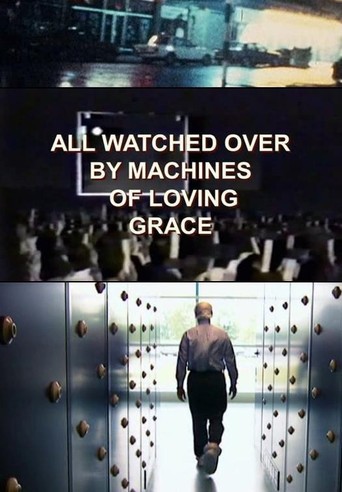
Roger Burke I generally watch documentaries based upon the topic or theme e.g. nuclear issues, language studies, ancient history, climate change and so on. Rarely do I watch one based upon the title only.This three-part examination of the relationship of computers to society is an exception: I was so intrigued by the title, having come from career of forty years in computers prior to my escape from corporate life, that I just had to see it.I wasn't disappointed. The writer/director (Adam Curtis) combines stock footage of computers, city and urban scenes, moody or discordant music, crowd scenes, famous people and a clever, cogent argument in an attempt to show the extent to which humanity has become entrapped by the IT revolution since the 1950s. It's a three part series and definitely worth every minute of your time. But, it's not only about computers...For starters, in Part 1, I could easily relate to Curtis's slant on the link between the extreme socio-economic philosophy of Ayn Rand that helped to influence Alan Greenspan's view of the world before and after various financial calamities, and up to the catastrophe of 2008. All of which was only possible – a crucially important fact – by pervasive, global computer technology used by greedy and opportunistic bankers, speculators and investors, all acting in their own self-interest.I can vouch for that, having been an insider with the online IT divisions of various banks in the UK and North America for fifteen years in the 1970s and 1980s. The standing joke in banks: you can't trust bankers. Wink, wink, nudge, nudge...Part 2 debunks the idea that nature is in equilibrium or seeks to find equilibrium. Instead, nature is in a constant state of flux and change, chaotic and unpredictable – and hence dangerous. (And, like it or not, humanity is part of nature.) This should be obvious – think of daily weather patterns globally. Curtis here links the emerging social networks as analogous to the chaos of nature which, coupled with our cancerous over-dependency upon computer technology, can only result in more unpredictability, uncertainty and opportunity for disaster. It's more than likely, I think, that Curtis is correct. To what extent, ultimately, is obviously opaque.Part 3 finishes the job in a somewhat elliptical fashion: you must follow the logic closely as we are introduced to an eminent scientist, William D. Hamilton and a brilliant mathematical genius, George R. Price. They argued that the real culprit in our chaotic existence is The Selfish Gene, a description that is now the title of Richard Dawkins's book that made him famous globally (It's an interesting, persuasive book and worth reading.) Humanity is then characterized as "soft" computer driven automata, explicitly removing the possibility of any spiritual or divine influence in human affairs.I can live with that, having decided long ago that we are all but organic machines with brains far, far superior to those "brains" of digital computers – thankfully. And the conclusion that crystallizes the essence of altruism – Ayn Rand's mortal enemy – is a tour de force of ironic tragedy.Graphically horrific images from recent depravities in Africa are interwoven to illustrate and prove the case; but it would totally spoil the finale to say anymore.Perhaps the editing of the series and some jump cutting are a mite fast at times; and the sound appears to fade occasionally. Apart from that, I highly recommend investing the three hours.Is Curtis showing us heaven on earth? See the movie. You be the judge.November 2011.
Chris Gill Adam Curtis' recent documentary series disappointed some. Compared to his work on The Century Of The Self and The Power Of Nightmares, it seemed hodge podge, lacking a central framework idea and bouncing all over the place.After twenty minutes of the first episode, I may have been inclined to agree – the documentary seemed to lack focus and carried over the experimental mix of music and image that had been used so successfully for the interactive theatre piece "It Felt Like A Kiss".However, having seen the full piece, I now beg to differ. If anything, the series is a broader and more satisfying development of areas touched on in his previous pieces, particularly Century Of The Self.As with Curtis' other work, it explores the far reaching and (for the most part) unintended consequences of big ideas. In this case, the idea that nature can be explained and entertainingly presents a series of case studies to explore whether this idea is flawed or not. Unlike his previous pieces, the period under discussion is very recent and the ideas explored so varied that each episode does not really follow a linear timeline and the debates bounce from the 1950s to the 1990s to the 1960s to the present day.This is a powerful and thought provoking piece, Curtis never comes across to me as polemical and seems happier drawing your attention that things may not be quite as they seem rather than hitting you over the head as he proves everything you know is wrong.Everything you know isn't necessarily wrong but it may be that you aren't fully informed of all the facts. The opening sequence may be the the weakest of the series, linking Ayn Rand's ideas of Objectivism to the development of moden computing. However, clever dick that Curtis is, it only becomes apparent with the patience to sit through this that the central character isn't Rand at all but a member of her social circle, Alan Greenspan – who, as chairman of the US Federal Reserve became, through a series of unforeseen events, the most powerful man in the world for a brief period.The subsequent rattle through the economic crises in the Far East in the 90's and the knock on effect to the current economic crisis in the West (and China's part in it) is eye opening to say the least. And it goes on, finding short degrees of separation from a multitude of players on the world stage, linked by the rise and consequences of ideas relating to systems. The second episode then explores the theory of self organising networks through cybernetics, eco politics, the geodesic dome, the 60s counterculture, maximum population growth to the Facebook/Twitter revolutions of the 2000s.I was especially impressed with the final episode exploring the theory of the selfish gene, moving from the initial theory through Anglo- American intervention in the Congo, myths on the origins of the AIDS virus, the Belgians role in the genocide of Rwanda through Richard Dawkins and Dian Fossey.Fascinating stuff and well worth three hours of anyone's time.
Guy ALL WATCHED OVER MY MACHINES OF LOVING GRACE is a documentary purporting to explain the negative impact of computers and computer thinking on our society. But as this is Adam Curtis making it the result is a documentary that ranges from gorillas in the Congo to Ayn Rand rather than taking a straight A-Z. Unfortunately, in common with much of his other work, despite the sheer breadth of material covered and Curtis's undoubted skills in melding image and music, the actual argument is extremely dubious, poorly argued, lacking in evidence and frequently incoherent.Instead the documentary relies on Curtis's soothing tones (he does the v/o) and constant changes in ideas, music and images, in order to bamboozle the audience. This method of constant change prevents you thinking clearly as your attention is always being called to something else. Once the programme stops and you begin to think about it without the benefit of music, image and voice, you realise just how dodgy the whole argument is.My other usual problem is that, whenever Mr Curtis touches on a subject with which I am familiar, I usually discover he is wrong or at least generalising to a dangerous degree. Thus the entire section on the decolonisation of the Congo basically blames the Belgians and more generally the West for the near immediate collapse of that unhappy country. There is no hint that the inhabitants of the Congo could even think or act for themselves. Curtis paints a picture of local tribes living in perfect pre-European harmony (conveniently forgetting the original inhabitants of the Congo - the pygmies) that is at odds with reality. There are a large number of similar errors. My worry is that, if Curtis is so often wrong when he talks about things that I know well, then is he also wrong about the things I don't know well?The sad thing is that every poor Adam Curtis documentary is an opportunity lost. The BBC has frankly given up on even trying to make documentaries on such complex subjects (even BBC4 is more arts than intellect). And nobody else has access to such a great amount of archive or the funds to really sift through it (hence why you always see the same archive on documentaries).