Acensbart Excellent but underrated film
Scarlet The film never slows down or bores, plunging from one harrowing sequence to the next.
Billy Ollie Through painfully honest and emotional moments, the movie becomes irresistibly relatable
Dr Jacques COULARDEAU He is the perfect king in Shakespeare's plays who reigns from 1413 to 1422, hence nine years. Shakespeare invested him in three previous plays, Richard II, 1 Henry IV and 2 Henry IV. But in these plays he is a kid and then a teenager playing it hooky in the taverns of London. But that time is now finished as we know from his rebuke to Falstaff on his coronation day at the end of 2 Henry IV. The man has changed and his most important achievement is the battle of Agincourt on October 25, 1415, the day that celebrates Saint Crispin that Shakespeare also calls Crispian who was put to death on October 25, 285. Note how the superstitious people of Shakespeare's time can jubilate on the fact that 285 produces 15 by adding the three digits of the date. Hence 1415 is a miracle date that brings God down on Henry's side to the point that the battle only kills twenty-five people on the English side, dixit Shakespeare, twenty-five to honor October 25, Saint Crispin's day. This English king who has the intention to unify England and France by marrying the King of France's daughter will fail in that respect since his son will only be six years old when he dies in the Château of Vincennes in France on 1422. Note though how they all are cousins or uncles. In other words these two crowns are systematically inbreeding. There is little clean blood and new blood in their descendants. Shakespeare seems to consider this as normal and even a sign of closeness, hence a justification for unifying the two crowns and of course the two nations that are seen and defined as being born under the kings of this period. The War of Roses is like a nation-forming civil war, a war between brothers and cousins, uncles and nephews. That's one of the results of this intense inbreeding. So Henry V marries his cousin. And their imposing the One Hundred Year War onto the French will enable the French to become a nation at the same time. That's the end of the play and the courtship of Henry to Katharine is both awkward and funny how Henry is behaving like a soldier and wants the courtship to be a battle and Katharine to yield to his might, and at the same time how Katharine is well-behaved and French-educated and she has to flee, fly away and flutter around, and she swiftly parry his assault, deflect his attack, block and avert his advance, counter and rebuff his intention, and finally repel and repulse his vanity to take as a conquest what should be received as a gift or a present. Luckily her father King Charles VI arrives and he can finally give his daughter to Henry and Henry can finally receive Katharine. The love words of Henry are vastly contorted by the linguistic game of both, Katharine trying to speak some English and Henry attempting the impossible task of speaking some French.The whole action of the play is one battle or nearly, the war leading to that battle, Agincourt, and it is thus entirely dominated by military questions. It contrasts the English army led by Henry V and the French army led by the Dauphin in the name of his aging father Charles VI. Imagine the French nobles drinking wine in the morning before the battle and boasting that they are going to defeat the English the way they gulp their wine. On the other side the English are austere and very serious in their concentration on God and his necessary help. The English are humble in many ways and the French are vain, as vain as peacocks who will end up plucked like chickens before roasting or broiling.In a very clear sign of defeat Montjoy, the French herald, appears three times. The second time he had said he would not come again, and the third time he comes to concede the day is Henry's, hence the defeat. Three is always a sign of a disturbance, a bad news, a catastrophe. But the catastrophe of one side is the victory of the other. And he will come a fourth time with the body counts that will settle the bad news and bring up a good news. First the French body count:"HENRY V: ten thousand, sixteen hundred mercenaries; The rest, princes, barons, lords, knights, squires, And gentlemen of blood and quality." (IV viii)And then the English body count:"HENRY V: Duke of York, Earl of Suffolk, Sir Richard Ketly, Davy Gam, esquire: all other men five and twenty." (IV viii)But the strong point is the night before the battle. On the French side they revel and are bored of waiting. On the English side they try to rest and concentrate on their divine mission. The king though tries something delicate: he hides himself under some cloak and goes around to check on his men. Security is correct every single time he comes up in the night. He finally sits with a group of soldiers and one of them, Williams, gets into an argument with the King, not knowing who he is, because Williams is not as respectful as he should be and Henry overreacts. But this leads to a deep and sad reflection of the king. He sees his place as the depositary of all the tasks and actions of the people but he also considers that the soul of these people is their own and they have to look after it themselves, as he says to the soldiers in the night.And then alone he gets onto a long reflection of the fate of a king, shifting from prose to verse to let us know he is reaching out to the sky, to God, to the truth of life he definitely considers as the truth of God.
bkoganbing Although this BBC televised play would as a matter of course lack the production values that Laurence Olivier and Kenneth Branagh brought to their films of Henry V, this adaption is second to none in the quality of the performance. In fact David Gwillim who had played Prince Hal in both parts of Henry IV grew into the role in a way that Olivier and Branagh never did.It is interesting to speculate how history might have changed had Henry V gotten a few more years. While British historians proclaim one of the greatest of monarchs, the French see him as slightly below Hitler as one of the greatest enemies of their country. As well they should, the English got battlefield glory, the French buried battlefield dead as the 100 Years War was fought in their country. He died a couple of years older than that other conqueror Alexander the Great and had both of them lived who knows what they might have achieved.Henry V is fulfilling the promise of greatness that he showed so little of as Prince Hal. The play concerns itself with his taking full command of the throne, executing some conspirators who were planning to assassinate him, and then achieving one of the great battlefield triumphs of the Middle Ages, the English victory at Agincourt over a French army that outnumbered them. Gwillim plays Henry with authority and decisiveness that rank with what Olivier, Branagh and others have done with the part.The BBC series of Shakespeare plays were productions of the highest quality. I only wish that they were all available in this country as this one was. I saw it when it first aired on American public television back in 1979 and it is still as good as I remembered it from then.
mhk11 I want to reply to one of the claims made by the 2010 reviewer (who puerilely refers to Shakespeare as "Will"). This reviewer states that the play is presented "with minimal, if any cuts." If the reviewer takes the time to read the play instead of making uninformed pronouncements about it, he or she will discover that numerous cuts have been made in the BBC's production. To be sure, most of the abridgments are pretty well judged, and there are considerably fewer abridgments than in the Olivier and Branagh versions. Nonetheless, the claim that the BBC's production presents the text uncut or nearly uncut is flatly incorrect.As for the production itself, it's quite a good rendering of an uneven play. I agree that David Gwillim is too "weepy" and "whispery", but he performs several of his scenes well (for example, the scene with the tennis balls -- until he starts to throw them -- the scene of the exposure of the traitors, and the scene in which he woos Katherine). His rendering of the magnificent St Crispin's Day speech is very disappointing, but his rendering of the riposte to Montjoy shortly after that speech is excellent. Likewise, although he starts the great "Once more unto the breach" speech quite lamely, he finishes it well. Other members of the cast are generally proficient. In particular, the actors who appear as the French nobles seem to enjoy their roles, and they perform those roles adeptly.
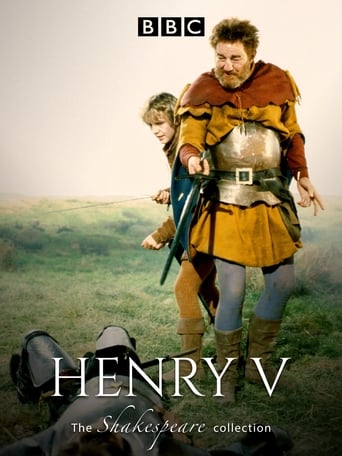
sarastro7 BBC's Henry V is good, but not great. In comparison with the much superior Branagh movie, this one seems rather tame. The dialog is not spoken with the awe that the words deserve. I like David Gwillim a lot (esp. in the two preceding Henry IV productions, which were better than this), and all of the cast are consummate professionals with clear enunciation.As Shakespeare productions go, this Henry V is a worthy and adequate one, but it is something short of extraordinary. As is the case with many of the BBC Shakespeare productions, this too is marred by a lack of real drama in the performance, and when you combine this with the enormous, almost ridiculous prevalence of always stout, always bearded, always middle-aged men in always exaggeratedly ornate costumes, back-dropped by unelaborate and uninteresting sets, the result unfortunately tends to be tainted with a certain dull blandness. No offense to the actors, who are faultless in this. But at least the words come through clearly enough, and the actors, while not allowed much range, do as immaculate a job as they can under the circumstances, which is why productions like this are justified in spite of their shortcomings.My last complaint regards the French princess, Katherine. The French actress is stunningly good-looking, and I can find no fault with her acting, but the director seems to have overlooked the fact that Kate is supposed to evolve. She starts learning English because she takes an active interest in her forthcoming match with Henry, and as he finally convinces her to yield to him (which she has already decided to do, despite coyly spending the last moments playing hard to get), she should give herself over entirely. That's part of her development. If she doesn't do that, there's no point in the scenes where she has her maid teach her basic English. But here, Henry kisses her twice, and on both occasions she does not respond at all; she does not kiss him back. I believe that is a misconception on the part of the director, who must have wanted to portray her more "historically" and/or "realistically", as a victim of circumstance rather than as an active participant in her fate. But Shakespeare is not literal history. Shakespeare is art. The historical Henry V spoke French like a native. Shakespearean interpretations and dramatic decisions should not be too tainted with historicity, at least not in so literal a sense.7 out of 10.