ThiefHott Too much of everything
Exoticalot People are voting emotionally.
Fairaher The film makes a home in your brain and the only cure is to see it again.
Invaderbank The film creates a perfect balance between action and depth of basic needs, in the midst of an infertile atmosphere.
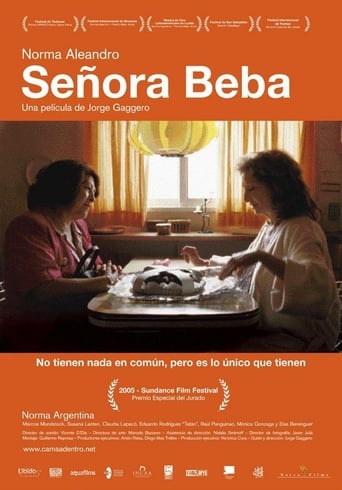
filmalamosa Senora Beba is a 50 something (approaching 60) woman who is having to learn to live with reduced circumstances. She is the perfect upper middle class rattle brained blond who is maybe really not so rattle brained.Dora is her live in maid of 30 years who is going to quit because Senora Beba can no longer pay her salary reliably.Neither one want this to happen.It is a wonderful look at life as you get older live alone and have less income.Both characters and the film are 100% real.This movie is a must see.
lfeet Cama adentro is a no-action movie that seems slow at times, but does a fantastic job capturing a surprising bond between women and their pride in a time of separate struggles. This movie is similar to other Latin American films in that it depicts the reality of friendships, the relationship between a lady and her help and the down turning economy that forced many people during the 21st century to struggle between dignity and survival. The slow tone of the movie illustrates both woman's tough lives at the current time; it makes it seem like the maid has tried to quit for a long period of time before finally resigning and it emphasizes the number of unsuccessful days and attempts Beba makes to try get enough money to afford her loyal Dora: her maid and only companion. The slow tone is not a boring tone though, it spares us tedious insignificant details that other movies may take the time to include. Another factor that stresses the depressing situation without verbal description is the repetition of monotonous activities that the Beba is constantly bringing up which are her hopeless attempt to sell a beauty line, her constant need for whisky and her detached daughter that Beba is naively dependent on. Hitting the emotion part of the audience, Jorge Gaggero manages to combine a realistic and depressing situation with characters that are both lovable. Capturing certain facial expressions and character interaction along with the camera angles and the mood he produces we get a real sense of pain and hard times along with the final resolution of happiness.
Roland E. Zwick Beautifully written and directed by Jorge Gaggero, "Live-in Maid" is a bit like an Argentine version of "Driving Miss Daisy." Beba (Norma Aleandro) is an aging divorcée from the privileged upper classes whose ever-worsening financial situation is making it harder and harder for her to maintain herself in the style to which she is accustomed - including paying the salary of Dora (Norma Argentina), her loyal but long-suffering housekeeper who has put up with her boss' moodiness, petulance and condescending attitude for thirty years now. Yet, as in "Miss Daisy," the relationship between these two women cannot be pigeonholed quite so neatly. In fact, their story, rich in ambiguity and emotional complexity, comes to reflect in miniature the much broader conflict that exists between the ruling class and the servant class in our society. In truth, there is no logical reason why these two individuals from wildly divergent social backgrounds should even be expected to get along at all. Certainly, Dora has every reason to resent Beba for her privilege, her rank and the often imperious manner in which she treats her. Yet, in her own way, the stoic, taciturn Dora comes to pity Beba for the hard times, both financially and emotionally, that the previously pampered woman suddenly finds herself going through. Indeed, things get so bad for Beba that she is forced to sell virtually everything she owns to keep herself afloat, and even has to humiliate herself by trading merchandise for food in a second-rate cafeteria. In addition, Beba's grown daughter wants to play as little a part in her mother's life as possible. In the same way, although Beba clearly doesn't treat Dora as her equal, she understands deep down inside that this "subordinate" is also probably the only real companion left to her in the world, the one person she can reach out to for comfort and support. The relationship between them may be one of mistress and servant, but the two parties also have much that unites them, including the problems common to women their age, their concomitant struggles with money, and the fact that fate has thrust them together for such prolonged and extended periods of time that they can't help but get to know one another on an intimate level. It is the discovery of their common humanity, brought about by this enforced closeness, that finally allows their relationship to blossom into a friendship between equals that crosses class lines.On a sociological level, the movie points out the irony that it is the people with the most power who, when the chips are down, are really the most helpless and fragile - and the people with the least power who are the most persevering and tough and seemingly most equipped to cope with the vicissitudes of life. Superbly understated performances by the pair of Normas - their scenes together are really quite breathtaking and quietly masterful - as well as flavorful and subtle storytelling make "Live-in Maid" an intensely poignant, wholly believable and thoroughly absorbing experience throughout.
rantchester This slow but involving human drama takes Argentina's recent economic meltdown as its prompt. Cama Adentro means 'live-in maid': Jorge Gaggero's sensitive film pursues the deep but uneasy relationship between the genteel, newly-impoverished Beba (Norma Aleandro) and Dora (Norma Argentina), the servant with whom she's shared her Buenos Aires apartment for almost 30 years.Sudden lack of money has flipped the pair's dependency. Unable to pay her maid for several months, lonely, prideful Beba stands to lose the only reliable company she's known (her daughter, like her husband, has previously departed - alienated, we're left to assume, by Beba's haughtiness). Dora, meanwhile, must decide whether to stay and assist her unravelling employer, or take her chances in an economy with fewer and fewer jobs.What could have become gooey and trite in the hands of a lesser director is instead rendered plausibly complex: the women struggle to preserve their dignity in straitened circumstances, and to forge a new accord based on mutuality rather than compulsion. Both Beba and Dora are endearingly flawed - the former supercilious and unyielding, the latter torn between contempt and sympathy for her former boss. Argentina is gruffly impressive as the emotionally-contained maid, while Aleandro's monstrous but piteous snob is an equally sharp portrayal. In Gaggero's measured telling, the pair's not-quite-friendship rings all the more true for being revealed with unsentimental compassion.