hamoo the thought "why write another review when there are already 177 of them" has already crossed my mind, so i'm just going to give my opinion: a lot of reviews crucified this movie because it doesn't jibe with the book. i didn't read the book, so it wasn't a consideration. i liked it because no one got blown up or shot. it was quite sedate; it made me fall asleep, so i missed a lot of it. i'm planning on going back and watching it again. movies that make me fall asleep get an extra star. i don't need to stay awake with my adrenaline pumping. also, i'm planing on listening to the audiobook next. maybe the contrapositive of naysayers holds true; maybe i won't like the audiobook because it doesn't jibe with the movie. typically, i like movies like "v" and "law abiding citizen", but i like movies like this also because they help me relax. i really don't need a whole lot of entertaining.
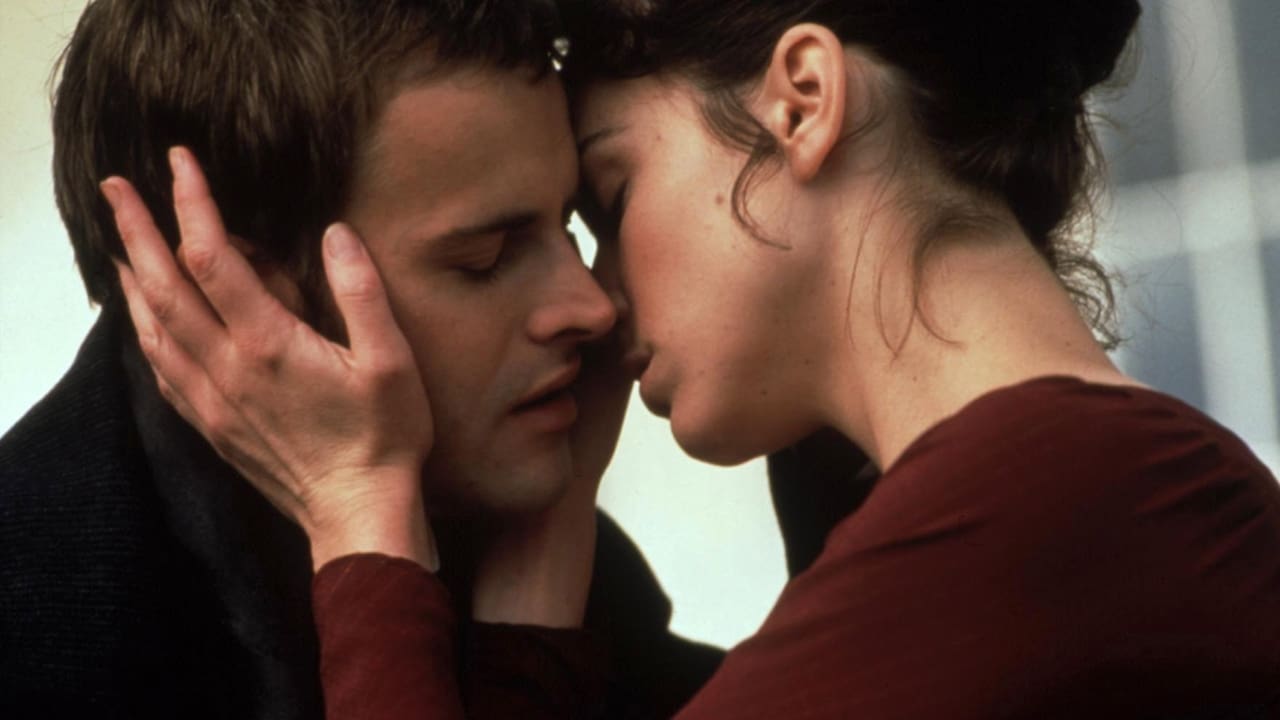
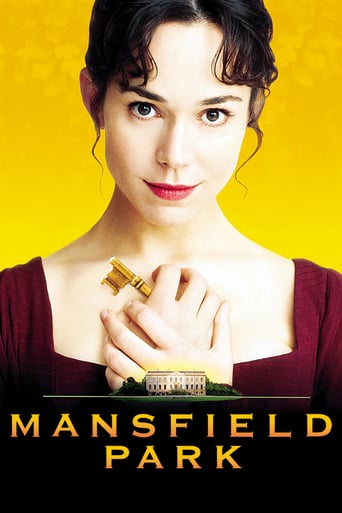
James Hitchcock Fanny Price, the daughter of a poor family in Regency England, goes to stay with her wealthy relatives, the Bertram family, in their elegant stately home, Mansfield Park. (Fanny's mother and Lady Bertram are sisters). Fanny falls in love with her cousin Edmund, the younger son of the family, who is in training for the priesthood, but he seems to be infatuated with the beautiful Mary Crawford. Fanny herself is pursued by Mary's brother Henry, but she distrusts him and rejects his proposal of marriage.Mansfield Park is, of all Jane Austen's novels, perhaps the most difficult to adapt for the screen. The main difficulty lies in the character of its heroine, Fanny Price, a quiet, timid girl to a modern audience can seem at best dull and insipid and at worst self-righteous and priggish Kingsley Amis went so far as to describe her as "morally detestable". This difficulty has not, however, dissuaded film-makers from trying to adapt the novel, as there have been two different screen versions during the last fifteen years. This film, dating from 1999, was the first; the second was the ITV television film from 2007 starring Billie Piper. Both films adopted a similar approach to what might be called the "Fanny problem", namely to rewrite the novel. Austen's Fanny is a shy, timid, sickly introvert. Fanny as played by both Piper and Frances O'Connor is an attractive, healthy, outgoing, self-confident and extroverted young woman, closer in spirit to some other Austen heroines such as Elizabeth Bennett or Catherine Morland. Both interpretations, especially Piper's, were attacked by the critics, but in my view the decision to reinterpret the character in this way was the correct one. What works on the printed page does not always work well on the screen, and a film which attempted to preserve the Fanny of Austen's novel would probably come out as intolerably dull, like the lifeless BBC TV series made in the eighties. The film's writer and director Patricia Rozema does, however, make further changes to the novel which work less well. In the original book, Fanny's family were not poor in any absolute sense, but only "poor" in comparison to the aristocratic Bertram family. By Regency standards they were middle-class; her father was a retired naval officer and they even employed servants of their own. In this version, however, her father is a labourer and the family live in quite genuine poverty. Given the snobbery of the age, it is difficult to imagine the Bertrams even acknowledging such an embarrassing family connection; if they wanted to do Fanny a kindness they might have offered her a position as a servant, but not as a companion to their daughters. Moreover, O'Connor's character speaks with a middle-class accent and displays evidence of a level of education far beyond that of most working-class girls of the period. Austen's novel did mention that Sir Thomas Bertram had business interests in the West Indies, from which it is fair to infer that he was in some way involved with slavery. This is not, however, a subject dealt with in the book; Austen had never visited the Caribbean and had no first-hand knowledge of slavery. The film, however, makes this into a major theme, with a whole sub-plot revolving around the issue. Sir Thomas's elder son Tom, who in the novel is a hard-drinking, profligate fop, here becomes a sensitive young man who returns home deeply disturbed by what he has seen in Antigua and it is implied that he becomes ill as a result of the shock to his nerves. There are other changes made to Austen's story. It is strongly implied, for example, that Mary Crawford is bisexual and attracted to Fanny. Henry and Maria Rushworth carry on their adulterous affair under the noses of her family in their own home; Fanny actually discovers them in flagrante delicto. The trouble with these changes is that they ignore the moral stance of Jane Austen's work without putting anything substantial in its place. "Mansfield Park" is an essentially conservative (with a small "c") work, a critique of what she saw as the looseness and corruption of the "progressive" morality of her day, exemplified by the dissolute Crawford siblings. Rozema tries to turn it into something much more politically radical, touching on modern concerns such as racism, gay sexuality and the class system but it just does not work as such. Subjects such as slavery in the nineteenth-century Caribbean, working-class poverty in nineteenth-century Britain, or even lesbianism in the Georgian era, might all make interesting subjects for a film, but I would not recommend Austen's novel as the starting-point for a film on any of them. This film was not a great critical success, but was not savaged quite as much as the ITV film, highly unpopular among bilious Janeites who loathed the idea of the former teenage pop star and pin-up Billie Piper, Britain's answer to Britney Spears, as an Austen heroine. (O'Connor, an Australian actress little known in Britain at the time, carried no such unwelcome cultural baggage with her). Yet I actually preferred the ITV version which, in my view, steered a successful middle course between staying too slavishly close to the original and departing too radically from it. This version has some good points; as normal with "heritage cinema" the costumes and the setting (Kirby Hall in Northamptonshire) are attractive and there are good acting contributions from O'Connor and Harold Pinter as Sir Thomas. Rozema's film, however, strikes me as a classic example of a film which does indeed depart too radically from the book on which it is ostensibly based, using it in an ill thought-out attempt to support a quite different political and moral agenda from the one the author had in mind. 5/10