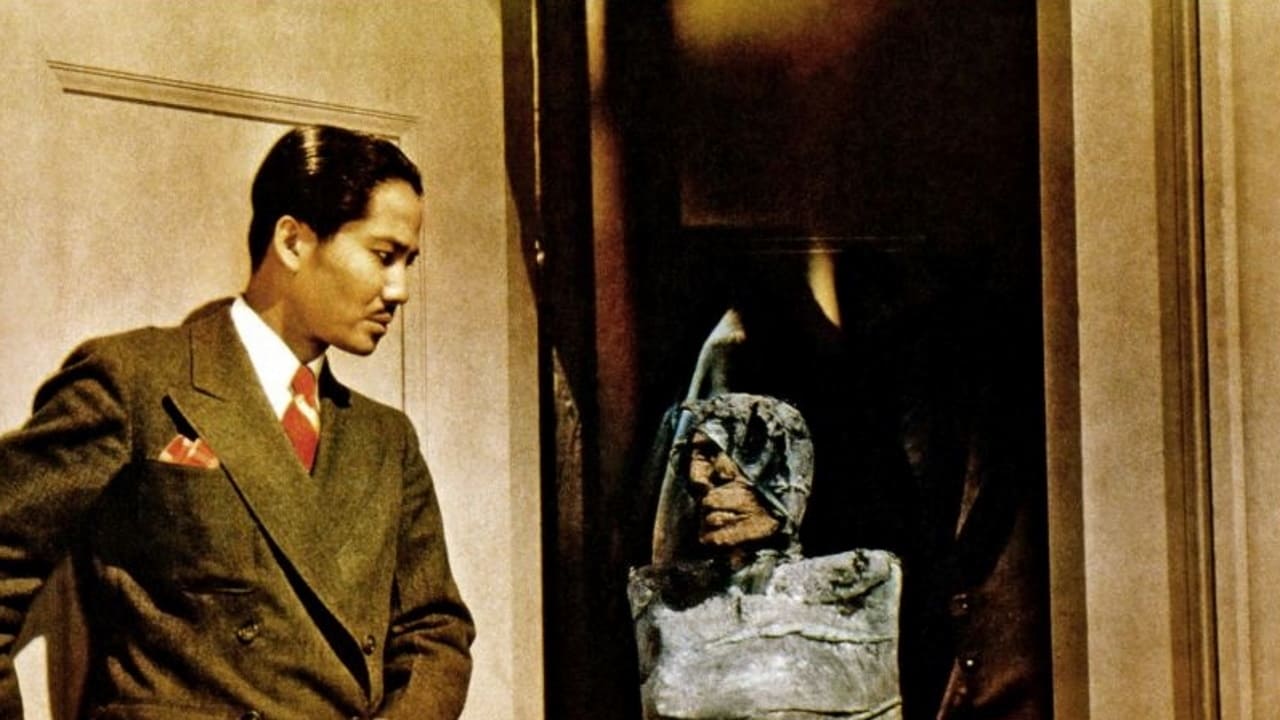
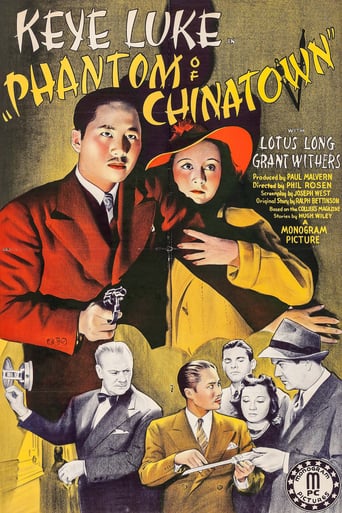
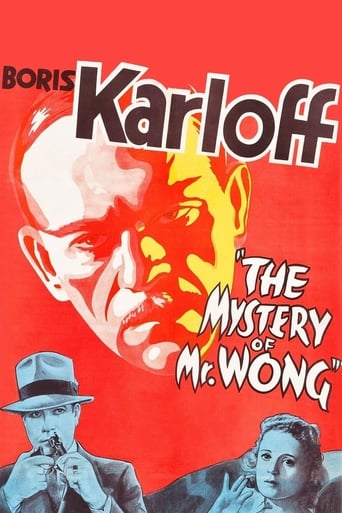
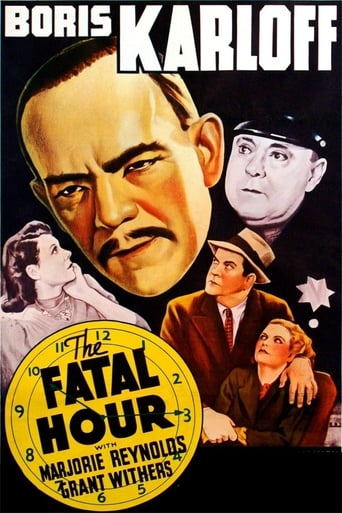
jakob13 'Phantom of Chinatown, released in 1940 by Monogram Pictures, known for low budget films, it is remarkable in that it momentarily reversed a trend in the detective genre.Keye Luke had the starring role in this predictable murder mystery, as James Lee Wong detective.Better known as Charlie Chan's number one son, Kato in the Green Hornet and the blind master Po in the Kung Fu, Phantom of Chinatown offered him the chance to defy the stereotyping of Asians in cinema.Although there were capable Asians to play the role, the role was given to a European or white American actors, extravagantly disguised as a creation of social and cultural mores of the time.As Sax Rohmer's idea of a Yellow Peril, British-born Boris Karloff became Dr. Fu Man Chu; the Georgian Akim Tamiroff the wily warlord in Frank Capra's The General Dies at Dawn or the Swede Warner Oland the deceitful war lord in Josef Sternberg's Shanghai Express.On the other hand, a more comic buffoon character Charlie Chan amused Americans for almost 20 years with his fortune cookie philosophy, oddly cadenced English and exaggerated gestures bordering on the obsequious, as he solved crimes the world over.A creature from the pen of Earl Derr Bigger, Chan reinforced the stereotype of Chinese. As a stock sidekick, he had his number one son, American born, educated and speaking a colloquial English to heighten the ridiculous among second generation born Chinese, who although born in the US remained 'foreign'. John Marquand's Mr. Moto, played by the Hungarian Peter Lorre had all the features of the Japanese that became more exaggerated and racist during world war two. Wily, clever and speaking correct English resonated through his nasal cavity, he too was mysteriously different as a solver of murder and mayhem. (Imperial Japan's bombing of Pearl Harbor ended the Moto series.) And then there was Hugh Wiley's creation in The Saturday Evening Post, James Lee Wong detective. Played in five films by Treasury agent Boris Karloff, who played him in a scholar gown, with a self- effacing and -deprecating manner.Karloff's English, correct as it is, distanced his Chinese detective by a lisp and a clipped to stress his foreignness.And the in 1940, Keye Luke plays Wong, the first Asian actor in a title role and a sound film as detective.Oh, what a difference: Luke's Wong is a Yale graduate; he speaks an impeccable American English; dress in a well-cut suit; he wears a dashing, raffish, pencil-like mustache, which makes him not only handsome, but shows that he is the leading man.Luke plays Wong with style, energy and youth enthusiasm, a good chip from the American Plymouth Rock.In consequent, the wisecracks and stereotyping are held to a bare minimum, a welcome relief.He's bright, no nonsense and lends an invaluable hand to the police captain who treats on an equal foot.The story line is formulaic, and tersely hold in a little over 60 minutes. The narrative holds our attention without taxing it.Of course what would a murder mystery picture with Asians be without exotic elements.. And Phantom of China doesn't let us down.Well we have scenes of the Gobi desert, search for a lost Ming Temple, an eternal sacred fire and a mysterious scroll to stitch the intrigue together.The murder is quick, by poison. The foot work quick without much fanfare to catch the killer.And there is the dead archaeologist assistant, played in a down-to-earth fashion by the Lotus Lang as Wen Lin, who keeps her counsel to herself.Wen Lin is written as a serious, supporting character whose manners and intelligence enhances the strength of Luke's Wong.Moreover, the film is peopled with many, nameless Chinese American actors and actresses who speak a standard English, are professional in demeanor and dignified in their roles. But for that one moment of stereotypical relief—Keye Luke's cook who speaks in a broken singsong cadence. And yet, he, too, is not made out to be a pumpkin nor a fool, the minor white detective assumes that role.Phantom of Chinatown directly shies away any allusions to the bloody Sino-Japanese war. Remember we are in an America with a strong isolationist streak, and substantial popular of America First, meaning keep out foreign wars.Suddenly the denouement is disconcerting: not in who the murder is nor his motive greed, but in the explanation of the scroll and the sacred fire that never stops burning.The scroll is the key to the secret of the Ming Tomb. It explains why the flame is eternal; it is fed by an unquenchable pool of petroleum that would be of great value to the forces of Chan Kai Check's troops fighting the Imperial Japanese invaders. (And by extension, after the war the fuel for China's growth and economic health.) Wen Lin is Chang's agent and as the film rushes to its conclusion, Wong and Lin will bring the news to China to bolster the war effort.Alas, the bombing of Peal Harbor put the kibosh on the Wong series, but not on the silliness of the Charlie Chan films.And no more did Hollywood until much later feature an Chinese or Asian actor as a leading man. And Luke went back to playing second banana and supporting roles.And it is this relatively obscure film that is worth reviewing for its brief breakthrough the walls of cultural racism in Hollywood and in America.
tedg I maintain that some very important conventions were worked out in 30s mysteries. The Charlie Chan series was instrumental in some of these, and this is the last of them. It incidentally has Charlie's son as the detective, the first Asian playing the character. The sensitivity to Chinese culture is no better than in the earlier movies, but that is a side issue for me. The wanted item here is a map to a vast oil deposit, discovered and stolen in the style of mummy movies.The interesting device is the use of a movie within the movie. The expedition had a filmmaker along whose filming gets mixed with conspiracy. The ancient scroll gets destroyed and converted to photographs.
utgard14 The beginning of this movie has an archaeologist unearthing an ancient tomb and subsequently murdered for it. No, it isn't a mummy movie. It's a Mr. Wong murder mystery. The last Mr. Wong movie, actually. This is today what we would call a reboot. They replace Boris Karloff with the younger Keye Luke, thereby restarting the series with a young Mr. Wong. It's interesting to see an actual Asian playing the lead role in one of these Asian detective movies, where a white man always played the part because it was believed at the time audiences wouldn't go to see movies with a non-white leading man.Keye Luke was an amazingly personable actor but this movie does not give him a chance to shine, forcing him to play Wong as a rather stuffy bore. Luke receives assistance from the lovely Lotus Long. They could have used this opportunity of a reboot to breathe some life into the Wong series, which was pretty stale. But instead this is quite possibly the dullest of the lot. Perhaps if given this shot at a better studio, it would have led to a long-lasting series with Keye Luke as the lead. But this is Monogram, king of the cheapies, so it's not surprising it didn't work out. Grant Withers was the only constant in all of the Wong films. While his character was a walking cliché, Withers played the part well.On the whole, the series was watchable but forgettable, even with Boris Karloff as the star. If you haven't seen many (better) B detective series, you might enjoy the Wong films more. But I've seen pretty much all of the them, certainly all of the major ones, and Mr. Wong does not stand up well.
bkoganbing As Boris Karloff moved on to bigger and better things in the horror film genre, the Mr. Wong series from Monogram got a final run with an actual person of Oriental heritage in the title role. Fascinating the mind set of Hollywood in those days.And who would it have to be for, but a poverty row outfit like Monogram in one of their series films. Keye Luke who moviegoers knew better as the number one son of that other Chinese detective Charlie Chan, gets to play a younger version of that noted scholar and criminologist James Lee Wong. Luke plays him just as Boris Karloff did as a man who went to both Oxford and Heidelburg and did not speak in fortune cookie aphorisms.But I'm sure it must have confused the living daylights out of the Mr. Wong audiences when the relationship between Wong and homicide police captain Street of the SFPD was so different. Grant Withers played Street in all the Wong films and he was not at all resentful about deferring to the older man's knowledge. The same way Captain Stottlemeyer defers to Adrian Monk on that show.But with Luke, Withers is at first downright hostile, in fact this film of necessity is set back to when they first meet and Withers most reluctantly bows to Luke's skill for investigation.The leader of an expedition to China where an ancient scroll was taken from a Ming Emperor's tomb is murdered while giving a lecture. And the scroll goes missing as well. There are a whole host of suspects, including a pilot that had been lost in the desert, but he turns up rather early in the film.It might have been nice if Keye Luke had inaugurated the series instead of an Occidental like Karloff, good as he was. History could have been made.