Pluskylang Great Film overall
ThedevilChoose When a movie has you begging for it to end not even half way through it's pure crap. We've all seen this movie and this characters millions of times, nothing new in it. Don't waste your time.
Lachlan Coulson This is a gorgeous movie made by a gorgeous spirit.
Freeman This film is so real. It treats its characters with so much care and sensitivity.
Amit Hattimare The story gives a very strong message. It starts simply as the story of a mechanic who just wants to complete his work and is ready to go against even his own people because he knows he's right. But soon it becomes a movie that tells us the importance of unity, and freedom that we get in this country. Somehow the movie, towards the end, makes one nostalgic and it is very emotional to see Gandhi's ashes being taken through a city's streets and everyone joins the convoy. It makes us think what we are doing wrong that is spreading hate or promoting bad deeds. It successfully makes us realise the efforts of a man to bring the people of this country together and form a free nation. Hats off to the director and all actors for pulling up a brilliant performance.
indianature I chanced upon this movie last week ... on Star Gold Select! Had never heard of the title but with Paresh Rawal and Om Puri in the frame, it seemed like a good choice to watch with nothing better to do at the time. It was indeed.Road To Sangam is an interesting story, realistically shot, with beautiful cinematography and of course outstanding acting.I confess that I do not know any more about Gandhi than what one had to per force learn by rote in school history, all long since forgotten. This movie kindled my interest and that alone says a lot for the film!The last scenes of the truck proceeding slowly to the Sangam and the hordes of people, ordinary people, that came out to pay their respects, was really touching.Thanks to the film makers for making such a movie which surely deserves a much wider audience. Do watch on the net or when it comes on TV. The 8 is only because it could have been a bit shorter.
rAjOo This is one movie that stands above all of Bollywood flicks during 2010.The movie does raise interesting issues such as the devastation of partition that followed India's independence from the oppressive and tyrannical British. While Hindus and Sikhs fled from what is now known as Pakistan, Muslims - especially the one who were affluent enough to afford to travel - were also compelled to flee - amidst scores of killings on both sides.Gandhiji had been frustrated with the verbal tirade between two of his followers: Muhammad Ali Jinnah (whose ancestors were Hindu Rajputs) and Jawaharlal Nehru. He had wanted Jinnah to become the first Prime Minister, but this move was opposed by Nehru - who openly stated that he would not even offer Jinnah the position of a 'chaprasi' in the new Indian cabinet.An enraged Jinnah declared that he will become Prime Minister even if it meant to form another country. And thus began the formation of East and West Pakistan - and the subsequent devastation that followed.Those Hindus and Sikhs, especially Sindhis, who fled from Karachi and other cities - were treated like refugees in their very own country. Gandhiji attempted to bring back Muslim brothers and sisters by announcing that he was going to lead a foot-march to not only compensate but also enable people to return to their original homes and livelihoods.It is not a secret that while Jinnah felt threatened by this movement, several Governors of the newly formed Pakistan openly indicated that they would return to India.Shortly before the foot-march Gandhiji was shot dead by a right-winged Hindu.His remains were placed in urns and immersed in Holy rivers and sites all over India.It is not a secret that with the immersion of his remains - Truth and Righteousness were also subdued and have ultimately disappeared from India/Bharat/Hindustan.Wealthy Maharajahs/Nawabs used their influence and became members of parliament, continued amassing wealth and ignoring the poor, and become tyrannical and oppressive themselves. Result: Rampart corruption in all walks of life, nepotism, favoritism, religious intolerance, violence, and terrorism continue unabated. If not for this partition, a united India would now be a power to be reckoned with.Funds and energy wasted on war, ammunition, defense, and counter-terrorism would have been used to improve the lives of embattled and impoverished citizens in all three countries - Bangladesh, India, and Pakistan.It is never too late as they say 'Subah Ka Bhoola Shyam Ko Ghar Aaye - Toh Ushey Bhoola Nahin Kahetey".
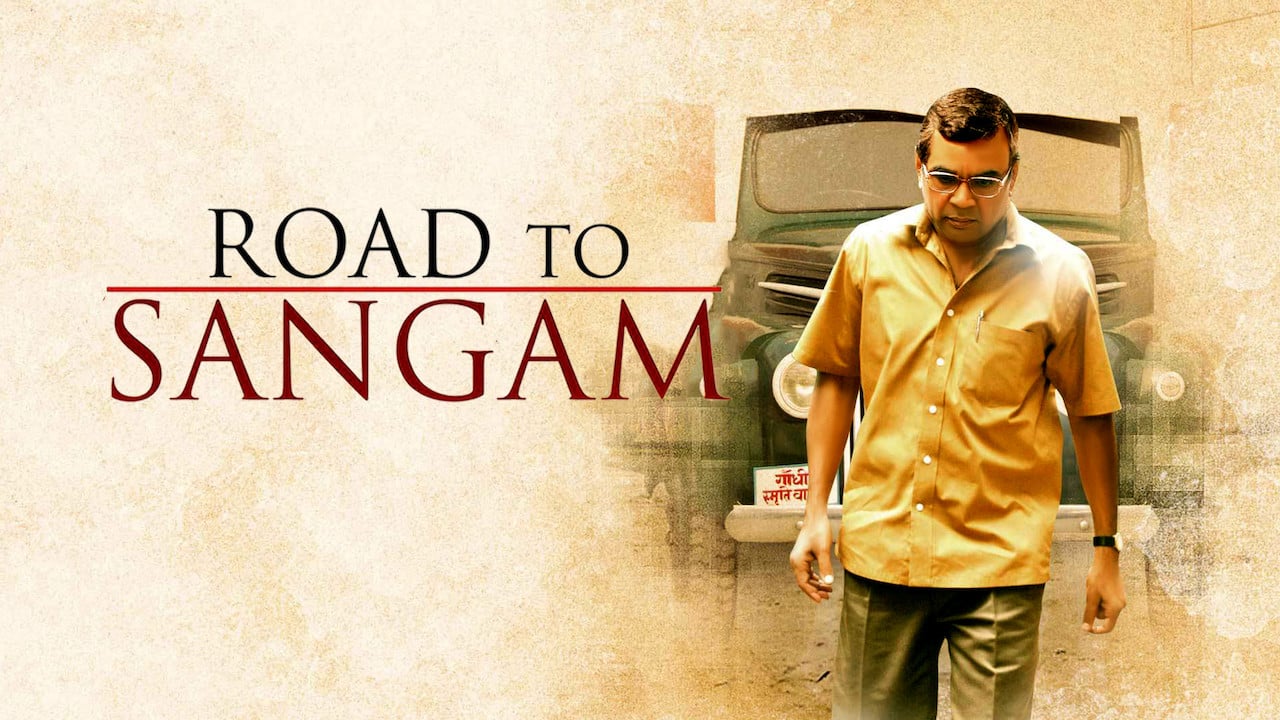
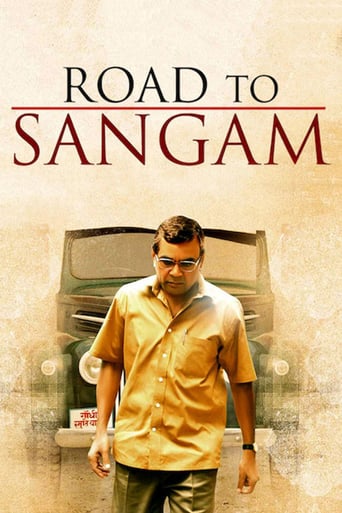
Shashi Krishna It somehow seems like every other unconventional Hindi movie these days is aligned to either showcase Mumbai's undeniable spirit as a city that has seen the heights of mass peril or to herald a pro-Muslim message to those who might not already have heard it. Of the two, if we take a look at that rather colorful array of movies that have attempted to paint Islamic fundamentalism in a shade more palatable to the untrained layman palette, some great examples ('Aamir','Sarfarosh'), some decent instances ('Anwar','Yeh Hai Mera India','Yeh Hai Mumbai Meri Jaan') and some Herculean debacles('My name is Khan', 'Kurbaan') come to the foreground. Whilst all the aforementioned movies had varying degrees of success with portraying the life and times of an ordinary Muslim in today's India, there has never really been an attempt to juxtapose the Muslim community against Gandhi's backdrop. For that, 'Road to Sangam'(RTS) has my respect.Now, I am not a hardcore Gandhian. I have read abundant material on the man, exhaustive literature on his legend and certainly seen a dozen variations of his mantra in recent celluloid years. Notwithstanding my personal views of the Mahatma, I was getting a tad frustrated at how almost every movie that used him as the nucleus, would invariably get so sugary at one point that one could die instantly from that lethal injection of diabetic shock. His message of global peace, non-violence and inter-communal brotherhood would be echoed way beyond the subtle reality it so desperately needed. Thus, making an erstwhile honest attempt, seem preachy and philosophical.What makes RTS more authentic in such a stereotypical scenario is how it attempts to demystify the reasons why Maulwi saahibs and other patriarchal Muslims are screaming from atop mosque enclosures and what the everyday worker is hearing sitting in front of them, convinced that they know more about what being a true Muslim is. RTS dissects that so neatly that it takes your breathe away.The premise revolves around Hashmatullah (Paresh Rawal), a renowned mechanic and a devout Muslim, who works out of his grease stained garage in Allahabad. He is the general secretary of his community's organization which is headed by one time friend Mohammad Ali Kasuri (Om Puri) and the local Maulwi Maulana Qureshi (Pavan Malhotra). Hashmat is a non-threatening fellow who sits in on rhetorical meetings spilling with the irate and cranky Maulwi's never ending rants about how Muslims are being targeted each day in today's India. Despite his ideology that are slightly different from that of his peers, he does not see the need to voice his philosophy in their presence. He nods his head, joins in their hymns and plays his role to the T.And then one day a bomb goes off. A few prominent Muslims are arrested by the police and this sends shocks of rage across the community. They unanimously agree to shut down their businesses in protest of what they are convinced is a racist act. Hashmat, without a choice, reluctantly joins in not realizing that a recent project that has come his way, of fixing an age old Ford's rusty and dead engine, is in fact of the same vehicle that had once carried the Mahatma's ashes after his death in 1948. This, for a reason he cannot completely fathom, changes Hashmat's priorities.On the one hand he does consider himself a true follower of the Koran and a blue blooded supporter of his organization. On the other, there is his conscience that continues to prick him into the confession that his little deed of helping the Mahatma's final bounty of ashes to be submerged into the Triveni Sangam (a spot where the rivers Ganga, Yamuna and Saraswati meet), somehow seems like a more justified statement of Muslim being a faith of peace, rather than shutting off work and listening to a radically inclined Mullah each day. Thus, aware of the respect he knows he needs to pay to the man who was assassinated for being an open supporter of the Muslims, Hashmat prepares to face the wrath of his own kin by reopening his shop to fix the engine. Hashmat's personal journey of awareness lit brightly by the knowledge of the true meaning of Islam culminates with the Mahatma's final journey into the rivers of the country he fought so hard to liberate.RTS is no average emotion-heavy movie that is high on religious jingoism without a clear degree of practicality. In fact, it is the most mature movie I have seen on the subject after 'Aamir'. If 'Aamir' was the attempt to present the true anti-thesis of a Jihadi, 'Road to Sangam' paves the way for more clarity on the difference between blind fanatic adherence to one's faith and the need to see the bigger picture. That bigger, brighter, and more appropriate picture.I would definitely recommend a relevant film like 'Road to Sangam' purely because of the honesty with which it unfolds its theme.