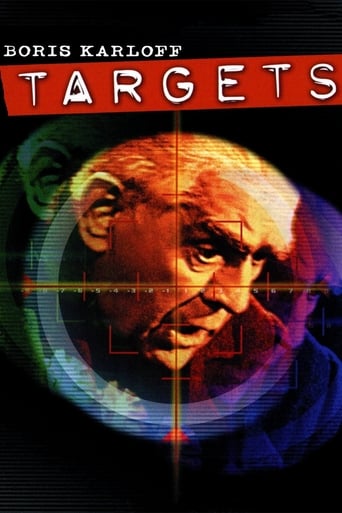
bombersflyup Targets is a pointless but engaging thriller, that is a mixed mess.So the film started off in another film and I had no idea what film I was watching or what it was about, so that was pretty cool. Every review raves about Karloff, I'm suppose to care who that is am I? I know he was in "Frankenstein". Anyway, he was fine, though the bit at the end where he walks up to the killer and slaps him is laughable. So Bobby says to his wife "You don't think I can do anything do you" and that is all we learn about why he goes off killing people. Byron says "Nobody cares about a painted monster anymore" and points to his newspaper about a shooting, when there is real horror out there. There are two separate stories and then the two come together in a silly conclusion. One with depth that is uneventful and the other eventful without any depth, you put the two together and you get? I don't know, an unwritten character that takes up half the screen-time. It's not a great film nor is it a bad film, it was fine.
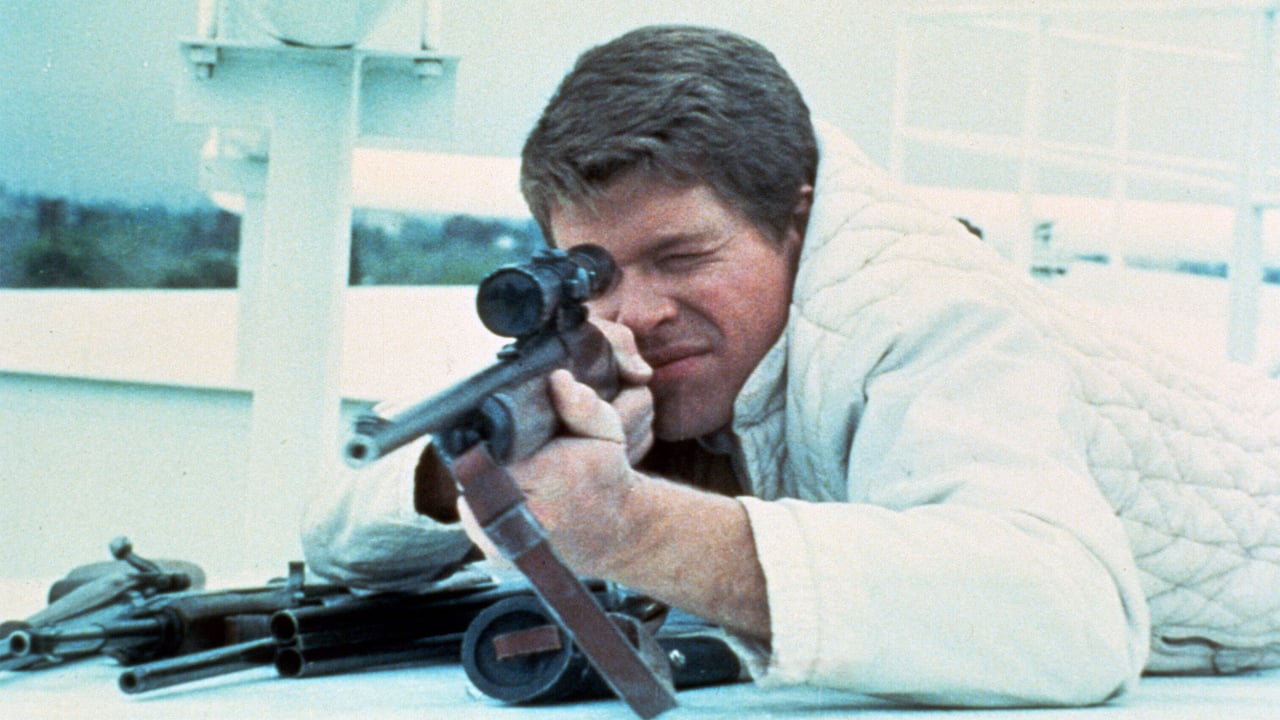
tieman64 "The sick individual finds himself at home with all other similarly sick individuals. The whole culture is geared to this kind of pathology. The result is that the average individual does not experience the separateness the fully schizophrenic person feels. He feels at ease among those who suffer from the same deformation; in fact, it is the fully sane person who feels isolated in the insane society — and he may suffer so much from the incapacity to communicate that it is he who may become psychotic. The crucial question is whether a quasi-autistic or low-grade schizophrenic disturbance helps us to explain the violence spreading today." - Erich Fromm In 1965, teenager Michael Clark positioned himself upon a hilltop overlooking Highway 101, south of Orcutt, California. Using a Mauser rifle equipped with telescopic sight he fired upon passing cars, killing three individuals and wounding six. Clark committed suicide when police rushed his hill. A year later Malcom X was assassinated.In 1966, Former US Marine Charles Whitman embarked on a shooting rampage at a university campus in Texas. He killed 16 people and injured 32. Whitman killed his victims from a university tower observation deck. Earlier that day he murdered his wife and mother at home. Two years later, Martin Luther King and John F. Kennedy were assassinated.Today, Roger Corman is well known for producing and directing a string of low budget B-movies and exploitation films. "Targets" is one of his most interesting. Seeking to exploit the string of assassinations and shooting rampages that were rocketing across 1960s America, Corman gathered together thirty thousand dollars, latched upon the vague idea of a film based on the life and killings of Charles Whitman, and hired a young Peter Bogdanovich to direct the film. "Targets" was Bogdanovich's debut. He was hired because Corman could pay him virtually nothing. Bogdanovich would go on to make a number of critically praised films, but few are as interesting as this nauseating little horror movie.Bogdanovich would write the film's screenplay with the help of director Sam Fuller, both artists elevating the film beyond your usual Roger Corman fare. Bizarrely, Corman stipulated that "Targets" include footage from "The Terror", a horror movie he had made years earlier. As ageing horror movie legend Boris Karloff, renowned for his roles in early silent and sound horror movies ("The Mummy", "The Body Snatcher", many iconic, early "Franenstein" movies and many Universal Studios horror flicks), owed Corman two days worth of acting, Corman also stipulated that Karloff be written into the film. Bogdanovich obliged.The end result is a film with two narrative strands. On one hand we follow Karloff's character, who plays an ageing horror actor struggling to find modern roles (an obvious allusion to Karloff and his own career), whilst on the other hand we follow a character called Bobby Thompson, a retired Vietnam veteran who seems like an upstanding, all American boy, until he embarks on a murder spree. Both narrative strands don't intersect until the film's climax.Much of the film watches from afar as Bobby does mundane daily activities - talking to his parents, girlfriend, co-workers, shopping, watching TV, sleeping etc – the film conveying a kind of depressingly hollow post-war America, in which cement, strip malls, drive-ins and junk food are the equivalent of culture, and in which everyone is atomised, automatised and drearily locked into their own private cubicles. The film's horror is apparent even before Bobby begins his killings, Bogdanovich latching on to a kind of banal, sunbaked, urban hell (the complete opposite to the romantic, moody, noirish urbana of "Taxi Drivr"); highways ceaselessly spinning cars like conveyor belts, gaudy post war architecture, antiseptic suburban homes, the giant, bland cisterns of oil refineries, the tacky warble of TV and radio. The film's aesthetic sickens. And then the killings begins.Bobby's murders are shot with a similar tone of ambivalence or detachment, Bogdanovich forcing us to watch as Bobby matter-of-factly shoots his parents and lover and then perches himself above a highway. Here he emotionlessly snipes the drivers and passengers of passing cars. No overt attempt is made to psychoanalyse or investigate Bobby's motivations. The film's tone is simply one of nauseating indifference. Unlike most horror/slasher/exploitation films, "Targets" never feels like its been designed to tantalise. Of course salacious plots and exploitative hooks were always Corman's chief aims, but Fuller and Bogdanovich short circuit their producer. How successful they are is arguable.The film ends with Bobby and Karloff meeting, fittingly, in a cinema. It is here where old-horror collides with new, the ancient, classic, black-and-white horror movie star of yesteryear facing up to and superseded by a new, nihilistic generation. Karloff's character hearkens back to Bela Lugosi, Universal and Hammer Horror classics. Bobby's Hitchcock's "Psycho", Powell's "Peeping Tom" and the gore, slasher, zombie and exploitation-horror waves that would follow. The film's climax plays like a raging metaphor for the collapse of the Motion Picture Production Code, the death of Old Hollywood, the stupidity of lax gun control laws, the disintegration of the nuclear family, the real results of post war economic expansion, the impossibility of the American ideal, and the festering rot behind both modern society and audiences, who demand blood as compensation for their own lives. It may be a cheap, trashy film, but Bogdanovich's tone homes in on a kind of wide-spread, societal dysfunction.7.9/10 – Worth one viewing.