Stevecorp Don't listen to the negative reviews
Intcatinfo A Masterpiece!
Calum Hutton It's a good bad... and worth a popcorn matinée. While it's easy to lament what could have been...
Logan By the time the dramatic fireworks start popping off, each one feels earned.
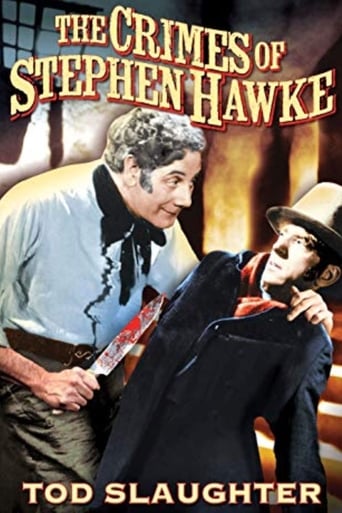
kidboots Tod Slaughter was as different as could be from his American counter parts Boris Karloff and Bela Lugosi. He was part of the British tradition of barn storming stage melodramas that toured the provinces in the gas light era. The audience would boo and hiss the villain, sigh over the heroine and cheer the hero. In Sydney, Australia, in the 1960s and 70s theatre restaurants came into fashion and Neutral Bay Music Hall changed it's program every few months. I remember seeing "The Springheeled Terror of Putney Green" (which Slaughter also made into a film), "Fleet Footed Jack" and "Her First False Step" - they were all great fun. Tod Slaughter was straight out of that gas light tradition, in fact the beginning of "The Crimes of Stephen Hawke" is at pains to point out that the plays the thing and it's all make believe.For the first ten minutes it is like a radio program with an odd novelty act "Flotsam and Jetsam" who seem to look at the daily papers for inspiration for their satirical songs. Then the announcer introduces Slaughter as having "murdered thousands of people and been hanged thousands of times" then Slaughter continues "yes and I'm still alive to tell the tale"!!! He then proceeds to tell listeners about his strangest role - Stephen Hawke, who is kindly yet a fiend. Within minutes "kindly" Stephen Hawke has left his trademark on a small boy who dared to order him from the gardens - "my garden isn't for people like you" the snotty nose brat tells him. Yes, Stephen Hawke is the "Spine Breaker", although to everyone in the village he is a kindly money lender who gives generously to his friends. Slaughter may not have been able to match his Hollywood co-horts as far as production values, but in evilness he was second to none. The thought of killing a child in the first few minutes would have been unthinkable to Karloff or Lugosi.His one joy in life is his ward, Julia, and it is at her party that the "Spinebreaker" strikes again. Only Nathanial, Hawkes down trodden clerk knows his real identity and also that his generous reputation hides a mean and cowardly nature - he gleefully turns a widow and six children out onto the street, all for owing 10 pounds!!! Suspicion now starts to fall on Hawkes, especially as people begin to notice his extremely strong hands and when his good friend, Mr. Trimble, dies, his son Matthew finally gets to the bottom of the hunt for the killer, who has escaped from prison by changing identities with a poor man who has just stolen a loaf of bread!!!Surprising to see that Eric Portman, such a distinguished actor of the 1940s, specialising in introspective, urbane villains, got his start playing the young hero in Tod Slaughter movies, this one and "Maria Marten". This definitely isn't my favourite Tod Slaughter movie, for anyone wanting an introduction I would recommend "The Face at the Window" (1939).
wes-connors "Stephen Hawke is a moneylender whose compassion for his clients is only outshined by his devotion to his lovely daughter. What she and the rest of the public don't know is that Stephen Hawke is leading a double life. At night, he becomes 'The Spine Breaker', a notorious killer with the habit of viciously killing his victims in the most horrible ways imaginable," according to the DVD sleeve's synopsis. Silly movie, enriched as much as possible by two under-appreciated British stars - murderous Tod Slaughter (as Stephen Hawke) and Shakespearian Eric Portman (as Matthew Trimble) - both deserving better productions.**** The Crimes of Stephen Hawke (1936) George King ~ Tod Slaughter, Eric Portman, Marjorie Taylor
chrismartonuk-1 The opening scene plays out like every parents worst nightmare as Tod - casing a large country house - tempts an inquisitive child to See "a paradoxical paradox" and gleefully breaks his spine. This film was made in the immediate aftermath of Sweeney Todd's surprise success across the Atlantic and shows every hint of being custom made to cash in on Tod's newfound success - he is even given a special introduction in the prologue. An original script - as opposed to a musty Victoria melodrama original - it is very much Sweeney Todd-lite as Hawke cracks lines about "getting to grips" whereas the demon barber made grisly puns on "close shaves" and "polishing off". Tod is allowed to be more sympathetic with this being one of his few films were he fails to lust after a girl less than half his age. He is even allowed to protect his girl's honour as he escapes from prison very cleverly and slays the lecherous Miles Archer who openly lusts after her. Instead, he is a proper Father to his "adopted" daughter who is allowed to shed a few tears over him after his fatal fall at the end. The rest of the cast is the usual thin gruel that surrounds Tod, with the sole exception of destined-for-bigger-things Eric Portman who brings as easy an authority to the role of the hero as he did to Carlos the gypsy in Maria Marten - especially in the scene where he - in pursuit of Hawke - makes himself at home in an inn and plants his feet upon the table. The usual black humour is present - one fellow inmate of Tod's in the cell who notes Hawke's strange attitude to imprisonment says "he must be married". The man was not only the cheap and cheerful British quota quickie answer to Boris and Bela but an entire theatrical sub-genre unto himself. Victorian melodrama never had a more stalwart champion.
gavcrimson You owe it to yourself to see at least one Tod Slaughter film. His signature movie Sweeney Todd, The Demon Barber of Fleet Street or the career overview Crimes at the Dark House are two of the best examples, but The Crimes of Stephen Hawke is a worthwhile introduction to his work. Like most of the early Slaughter movies it seems uneasy about the (then) new film medium favouring more common forms of entertainment. His debut film Maria Marten or the Murder in the Red Barn opens with the entire cast being introduced like in a play and Crimes opens like a radio show complete with some hard to watch variety acts (singers Flotsom and Jetsom and a `comic' butcher) before Tod Slaughter is brought on to introduce his latest piece of `Strong Meat'. In the subsequent film/ radio play Slaughter (real name: Norman Carter Slaughter) plays the title role, an outwardly respectable moneylender who is really serial killer `The Spinebreaker' nicknamed for his ability to snap his victim's spines. His long time friend Joshua becomes his latest victim, however upon discovering the guilty party Jossua's son seeks revenge, forcing Hawke and his sidekick, an eyepatch wearing, one legged hunchback to flee, leaving Hawke's adopted daughter in the blackmailing hands of an upper class `lecherous brute'. For a film that barely passes the hour mark this manages to cram allot in, including a fake `talking' corpse, Hawke sent to jail for a year (for stealing a loaf of bread!), the obligatory romance, the honest guy vs the slimey rich guy for Hawke's daughter's hand and even some unexpected sensitivity. Its worth noting that the British censors banned all horror films during the WW2 years, although this falls a few years short of the censor's ban, during that time Slaughter was still making `meldrodramas' with tent pegs pounded into heads, human flesh stuffed into meat pies and lines like `I'll feed your entrails to the pigs' that were far more lurid than any banned Hollywood horror movie. Crimes opens to a sadistic scene where a pompous child is attacked by Slaughter and has his back broken, such scenes like that are not common in British movies of the time. Equally don't look for sub-plots about people being tortured with whips in Ealing comedies. Yet Slaughter's performance is incredible, extremely theatrical and barnstorming par excellence. You can almost hear the boos from the audience as he exits a scene giggling and cackling after `coming to grips' with some unfortunate. Some of the berserk expressions he makes in this film as he breaks spines makes it hard to believe he hadn't completely lost his mind. Call it hammy or over the top, but you'll never forget it. The director George King deserves credit for preserving most of Slaughter's body of work on film (even if he doesn't do it very well). Seemingly more comfortable on stage than on film, Slaughter's movies are little more than filmed plays, with cardboard sets, minimal (if any) camera movement, and unexceptional repertory players. Slaughter is the only reason to watch any of his films, for further proof see King's other Slaughter-less films like The Case of the Frightened Lady (1941) the old magic simply isn't there. Tales from Slaughter's theatre days are both hilarious and the stuff of legend. Actresses not needed would dress as nurses (in case anyone died of a heart attack), while Slaughter reviled in the sort of grand guignol butchery that could never be shown on film and would walk around after the show in blood stained clothes. Whether all these tales are true its hard to know. My relatives remember seeing the guy `live' sometime in the Forties and the man himself definitely left an impression running around the audience covered in blood (actually beetroot juice), waving a big knife and offering to `polish people off'. Now dead for nearly half a century, Slaughter's films are the nearest we'll ever come to experiencing such mad genius first hand. Technically the movies should be unwatchable, but they exert a strange fascination that you'll have to see for yourself, there really hasn't been anything like them before or since.