Platicsco Good story, Not enough for a whole film
Tymon Sutton The acting is good, and the firecracker script has some excellent ideas.
Taha Avalos The best films of this genre always show a path and provide a takeaway for being a better person.
Haven Kaycee It is encouraging that the film ends so strongly.Otherwise, it wouldn't have been a particularly memorable film
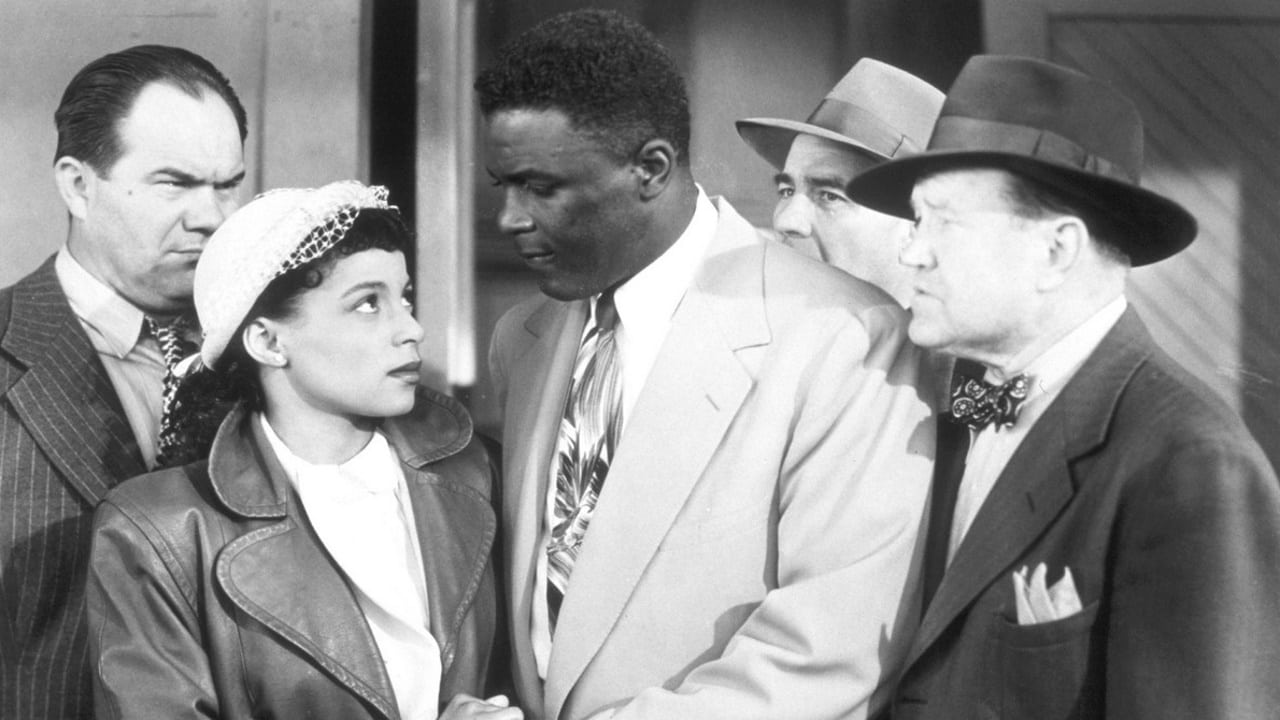
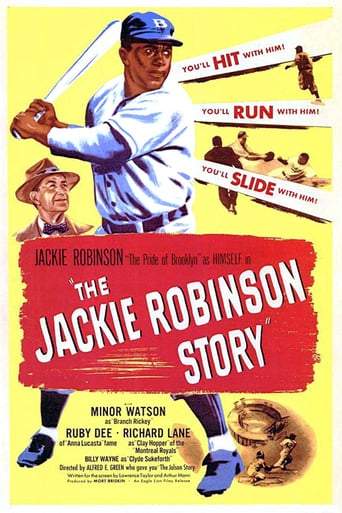
lastliberal Sure, many can criticize this film for what it didn't show, but it's a movie, not a mini-series. So, they had to gloss over the fact that his brother Mack (Joel Fluellen), with a college education and an Olympic medal was a milkman; didn't touch on the Army at all; and left out Satchel Paige.What was worth watching was Robinson'e play for UCLA and branch Rickey's (Minor Watson) valiant efforts to get him into major league baseball. It is no secret that I love watching baseball movies From Fever Pitch to The Natural to "A League of their own;" I'll watch baseball movies over baseball games. This was a good one. Robinson did a very good acting job playing himself. Of course, as Ringo Starr said, "All I have to do is smile and act naturally." Well, he did much more that that.So, head on over to the Internet Archive and check it our: http://www.archive.org/details/Jackie_Robinson_Story_The
wellsortof I decided to watch this movie because it was listed as one of the 300 titles chosen for the AFI's newest top 100 movies list (inspirational movies). I think that it could have made the list if (1) someone other than Jackie Robinson was playing Jackie Robinson, and (2) they would have made the movie with a more complete look at his life. By having the star play himself, it does a decent job of showing what he was actually like. He obviously understood what was so important about keeping his demeanor in check, always being polite to the manager and other teammates, etc. I think I've heard stories that, when he was actually on the baseball field, he was one of the toughest, meanest SOBs ever in baseball. That would make sense as compared to today's Michael Jordan or Tiger Woods, who are one thing to the camera, and another on the playing field. I think it would be in great interest to have this movie redone, showing his entire career (including the Brooklyn Dodgers' only championship in 1955) and his future work to build up the black community. It was sad to notice that, with the movie being only 77 minutes long, some parts actually seemed to include filler (ex: the large amount of play-by-play calling that seemed quite unnecessary). Plus, it would have been nice to have had a larger part for the brilliant Ruby Dee as his wife. So, to conclude, it's not a bad movie, but it lacks the full story of his life to be really great.
mschamberg I think this movie had really bad production value. The lack of acting makes me think they should mark it as an early docudrama. It may have had no money available for its making. I feel bad that it was a ruff ride into the Major League for Jackie Robinson.I believe he was much better than many of the white players of his day. He had to be really great to break the color barrier of the time. No getting around that this was a really bad movie.Wish there was more info about its makers. They may have been limited by the quality of actors that were willing to take on the project. Maybe no money to get good people.
Mark_McD If the obviously affable Robinson doesn't come across as a "good" actor, it might be more the fault of the production than himself. Though it's an important movie about a great sports pioneer, it has too many marks of a B-movie production. Too much exposition by characters who should have more interesting stories (wouldn't you want to know more about the USC athletic director who said the only color he cares about is "blue and gold?" Also, Louise Beavers gave a very subdued performance considering it was one of her few roles where she wasn't playing someone's maid. Other hallmarks of the B production were about two minutes of running used for the stock footage of calendar leaves falling to mark the passage of time, the old "spinning headlines" of newspapers with the same articles beneath, the fact that Jackie's baseball scenes were shot at just two ballparks (I'm not even sure his Dodgers scenes were shot at Ebbets Field; the field doesn't quite match the long shots of Ebbets) and the "flashback voices" that ran through Jackie's head when he was set to fight with some white hecklers. This film could also be considered as a product of the McCarthy era in which it was made. It did ignore Jackie's problems in the Army (because it's "un-American" to criticize the military) and ends with Jackie's flag-waving radio address before Congress. Branch Rickey, who in real life did spend several years trying to get pro baseball to desegregate, has a lot of "let's behave like real Americans" dialogue, but tempered with his admission to Jackie that he scouted him because we wants the Dodgers to win a pennant. Despite my quibbles, I think this is an important movie and I'm glad it's around for us to see. I am also torn between feeling that it might be better remembered had it not been a small studio picture, and the possibility that a major studio would have completely glossed over the prejudice portrayed in the film. <i>Note: Jackie's Dodger uniform number, 42, had been officially retired by every team in Major League Baseball. "42" is also the Ultimate Answer to Life, the Universe and Everything, as explained in "The Hitch-Hiker's Guide to the Galaxy." Coincidence? I think not.