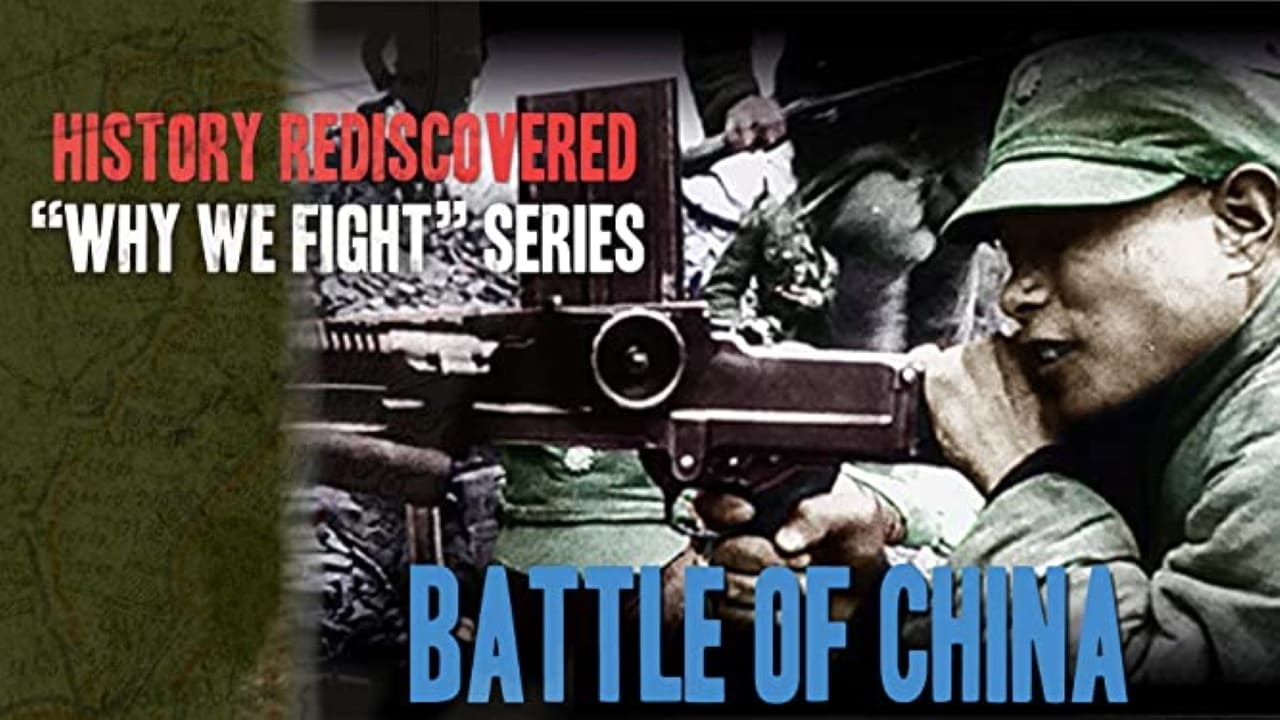
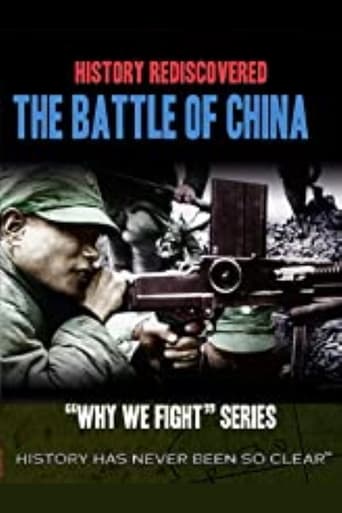
dimplet This is not a propaganda film; it is an un-propaganda film, as in the "un-cola." If you want to see what propaganda looks like, just turn on Fox "News." "Why We Fight" is pretty straightforward about it's purpose: It is an explanation of how America and its allies got into World War II, and why we need to win it. But the Battle of China is more than that; it is a history of China, a portrait of its people, a description of its geography, as well as a detailed account of the actions of Japan, China and the Allies in the war, up to that point.It is mostly a statement of facts,aside from the occasional remark about the war as being one of civilization vs. barbarism, or something like that, which is a fairly objective assessment of Imperial Japan and Nazi Germany, and the behavior of their soldiers. As with his populist movies, Capra builds up feeling through his presentation of people and events, rather than hitting you over the head with moralizing.Most of all, the movie is factual and accurate, as far as it can be, given that the war was in progress, and we did not have access to information historians now have. We would now say that the film is too kind to Chiang Kai-Shek, who Gen. Stilwell and President Truman had little respect for; but what do you expect in the midst of the war? On the other hand, it is quite sympathetic to the guerrilla fighters, who I assume were affiliated with Mao.I daresay that most viewers would learn quite a bit about history by watching this, whether they are Americans or Chinese. I don't think the Chinese are aware of the support they received from America, who was their ally even before Pearl Harbor. Our support for China in the 1930s may have played a role in prodding Japan to attack us at Pearl Harbor.The film is also interesting because of the historical footage showing China, its people, cities and farmers, before the war. You look at it and get a sense of its diversity of people, and that it was making a deliberate, well thought out effort toward modernization early in the 20th century. If the war and Maoist Communism hadn't intervened, China would have modernized, perhaps earlier. And in the portrait of China of earlier times, you get a sense of the character still alive in China today, of a reasonable, hard-working, progressive people.To fully appreciate the style of this film, one must be familiar with Frank Capra's feature films, such as Meet John Doe, Mr. Smith Goes to Washington and It's a Wonderful Life. Capra has always had a great love of the little people, the average Joe, and you see that respect in his portrayal of the Chinese people. He also has great admiration for American values, and you get the sense of the compatibility of Chinese values, not, perhaps coincidentally, because of the purpose of this film. But you see that respect for China also in a film he made 12 years before, The Bitter Tea of General Yen, so I believe it is sincere.Why We Fight was made to be shown to the American and allied military, as well as in movie theaters back home, and in Britain.It was the idea of the great but modest General George Marshall. If I were a soldier watching this during World War II, I would come away knowing a lot more about China. I would also understand the strategy and battles to that point, and be in a better position to grasp any future orders.The remarkable thing about World War II is how much it resists efforts to encapsulate it in one hour packages or series. There is always more to the story. In China's case, there was the role its people played in helping the downed fliers of Jimmy Doolittle's raid over Tokyo in 1942, who had to land or crash their planes in China because it was impossible to return to their aircraft carriers.This film is still relevant today because of the limited and somewhat distorted view China and the U.S. have of each other and the history of their relationship.
classicsoncall The sixth installment in the "Why We Fight" series explores China's history, and Japan's four step plan to bring China and the U.S. under Imperial domination. The first step was the largely unopposed invasion and conquest of Manchuria in 1931, to be followed by the conquest of China proper for manpower. With an initial attack on Shanghai in 1932 largely ineffective, Japan waited another year before taking over another Chinese province, while attempting to stretch it's reach further westward as the Chinese retreated. China's strategy was to trade space for time in an effort to build their military supplies. However Japan hadn't counted on the fierce opposition of Chinese guerrilla bands who continuously harassed the enemy.Bogged down by an inability to complete the second phase of their strategy, Japan embarked on the third and fourth parts of their plan. By the time this film was produced, Japan was in the midst of that struggle, with mentions of campaigns in the Pacific and the attack on Pearl Harbor setting the stage for the seventh and final chapter of this documentary series. I found that to be rather interesting, as the series now more closely resembled a work in progress as opposed to the history of the conflict already presented in the first five chapters. Interesting too because brand new American fighting men seeing these films for the first time might still have harbored doubts about the war's outcome, even if their country was now firmly behind the war effort.As in all the prior chapters, the atrocities of the Axis enemy, this time Japan, were well documented and horrifyingly portrayed. The fall of Nanking for example, resulted in the deaths of forty thousand victims, most of them non-combat men, women and children on whom the Japanese took out their rage and hostility. Unlike watching a war movie, the unimaginable terror that humans are capable of inflicting on each other is on display here in all it's unflinching reality.
Michael_Elliott Battle of China, The (1944) *** (out of 4) WW2 documentary from Frank Capra tells the history of China and their wars as well as how they got involved in WW2 and what they had to do to defend themselves. As with Capra's other WW2 docs, this one here contains some great battle footage, which is pretty remarkable to see. I also find it incredibly interesting at how Capra set these films up so that the viewer gets to know every little detail of how the war was fought. Sensitive viewers might want to stay clear because this is a pretty damn violent film that shows several people being executed by the Nazis and there's also some graphic footage of some babies that were executed.
planet groovy This, like the other films in the series, is a propaganda film. That being said, it is a very good documentary. This is due to three reasons. 1)Capra was a very good director 2)It is truthful - the information is not skewed by the film's agenda and 3)the battle footage speaks for itself. The narration is a bit overdramatic, but that is typical I think of movies in this era. I enjoyed this and will definitely watch the other films in the series.