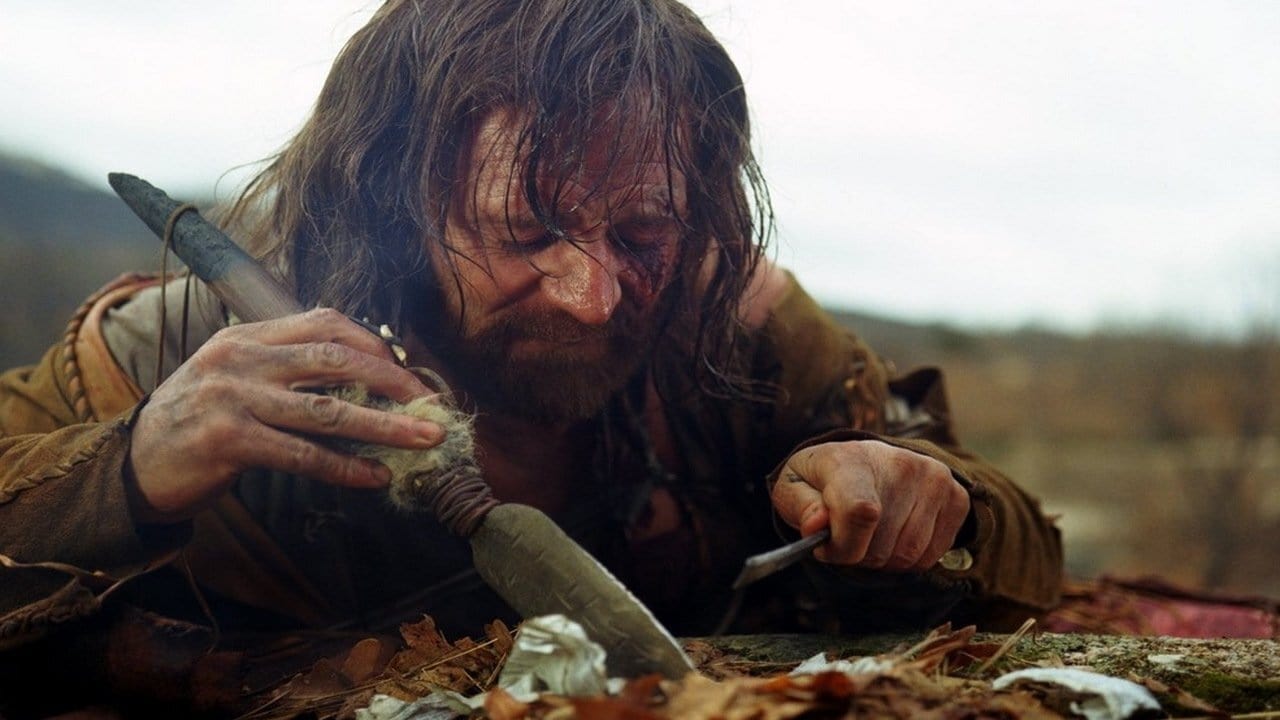
navigat361 If you liked Jeremiah Johnson, you'll like this. Classic story of the fur trappers. Good period Garb, great acting by Harris and Huston. Moving plot. One of my all time favorite "Western America" movies. Harris, (Zach Bass) starts out as a veteran Scout for a Fur trading company heading West. Bass is attacked by a Grizzly Bear while hunting for meat for the Fur trading company. He is mauled and seems fatally wounded. Huston(Capt Henry) decides to leave him behind , with two guards, until he dies. Then the Indians get involved, the guards flee in fear of being killed, and Bass is left to fend for himself. The rest , I cannot tell. It is an inspiring movie, with Bass going back to childhood and his young adult years in dreams. Old Americana it is. and a great period movie. SEE IT!
weezeralfalfa This film gives a rather graphic idea of what it took for the real man Zach Bass is based upon, Hugh Glass, to survive and reach a distant outpost of European civilization, after being badly mauled by a mother grizzly and left for dead by his companions. As such, it ranks among the elite in unbelievable survival stories.The film begins following Glass's account quite closely,but gradually diverges somewhat as the story continues. Whereas Bass's companions are returning southward with the year's furs, Glass's historical mauling occurred while they were en route northwestward toward Ft. Henry, near the present MT-ND border.I wish the film had continued to follow Glass's account of his journey to Ft. Kiowa, in present central SD, being aided by Sioux at one point. The film fails to give credit to his subsequent perilous search for all those responsible for leaving him to die, some of whom had since left the expedition. This search for explanation and vengeance consumed about 8 months, much longer than his original epic journey, and often involving traveling long distances alone in winter over the northern plains, with the ever present dangers of hostile 'indians', wolves, starvation and freezing to death. During these journeys, he should have died at least twice, along with most of his companions, at the hands of the Arikaras, and was reported as apparently killed for the second time in less than a year. In a sense, in the film, this period was fused into Bass's epic journey, when he had to travel through snowstorms and snowfields before catching up with his companions. Glass's epic journey occurred from late Aug. to early Oct.Of all the men on the real expedition, Glass was probably uniquely qualified to have any chance of surviving his severe injuries. Although he was around 40, one of the oldest expedition members, he obviously had a very resilient physical constitution. He also probably had the most experience in this environment, having spent several years with the Pawnee after being captured, absorbing their survival skills. He also had incredible luck over the years in surviving situations that his companions often didn't survive. Finally, he was basically a loner, used to relying on himself to survive in this challenging environment.Perhaps I don't fully understand the symbolic nature of John Huston's role as Captain Henry.He seems like a Captain Ahab-like figure, riding on that keelboat on a wheeled carriage, being hauled overland by a team of mules and men. When the men object to the insanity of this operation, he replies that the boat is his only remaining symbol of command of this expedition. In place of Moby Dick, he has a paranoid fear of Bass(Richard Harris), based on his past experience of Bass having a seemingly supernatural ability to escape certain death. Thus, even though Fogarty and Lowrie swear they buried a dead Bass, taking his survival equipment, Henry is certain he is alive and seeking revenge, and periodically looks in the distance for him. Fogarty begins to share his paranoia, and shoots into the darkness around their camp, certain he saw Bass hiding. Of course, Bass does eventually appear. But, instead of being a nightmarish seeker of revenge, he inadvertently saves the others from an attack by a large party of Arikaras. Evidently, the Arikara chief is impressed by Bass's bravery and skill at surviving alone, and decides to spare him and, by extension, the other expedition members, whom he has not yet joined. Yet again impressed by the quirkiness of fate, Bass decides not to press his desire for revenge and, after retrieving his rifle, walks off into the unknown, perhaps having concluded that he is better off relying on himself for survival. Captain Henry seems to sympathize with this decision. If this interpretation is correct, Bass is basically like Jeff Webster in "The Far Country", who prefers to face adversity by himself and not get involved in other people's problems, having been betrayed by others in the past. Alternatively, one reviewer suggests that Bass was going home to see his small son. The first interpretation is more in keeping with Glass's subsequent life.Incidentally, the real Glass did not forgive Fitzgerald, whom he most blamed for his abandonment. Rather, he was refrained from killing this man only by the fact that he had since enlisted in the US army, with a capital penalty for his murder. He had earlier spared Jim Bridger because of his youth and the fact that Bridger had felt compelled to follow the lead of his older companion. Of course, Bridger would go on to become one of the grand old men of the West: one of the lucky few to survive all the hazards of this life.During his epic journey of rebirth, Bass witnesses a squaw brought into the woods, then left alone to give birth in the traditional squatting position. Later, her husband returns to help with the infant and take her back to the village. This brings back memories of Bass's deceased wife and his small child. But, I think he also identifies with her as someone who must also sometimes endure great pain and loneliness in order to fulfill her purpose in life. This helps give him more determination to survive his desperate situation.
FightingWesterner Richard Harris is horribly mauled by a grizzly bear and left to die in the primeval forest of 1820's America, by trapping expedition captain John Huston. The injured Harris is forced to go to extraordinary lengths in order to survive and catch up with the rest of his party.A very offbeat, handsomely produced outdoor adventure, Man In The Wilderness is a story that's told primarily in pictures, with very minimal dialog. This moody, sometimes cerebral film might not be for everyone, though others will find it quite satisfying.Richard Harris delivers a great performance, despite the fact that the script only allows him to speak five times during the movie, three of which were near the end. He's forced to convey emotions mainly through body and facial expression.Some favorite scenes are when the trappers are pinned down by the weather and begin to imagine a vengeful Harris, coming out of the wilderness to get them, and of course the fascinating climax and finale.The film's basic premise was borrowed four years later, in the bad drive-in movie Apache Blood. That film is not recommended, whereas this would make a pretty good double-bill with A Man Called Horse or Jeremiah Johnson.