Solemplex To me, this movie is perfection.
Wordiezett So much average
filippaberry84 I think this is a new genre that they're all sort of working their way through it and haven't got all the kinks worked out yet but it's a genre that works for me.
Darin One of the film's great tricks is that, for a time, you think it will go down a rabbit hole of unrealistic glorification.
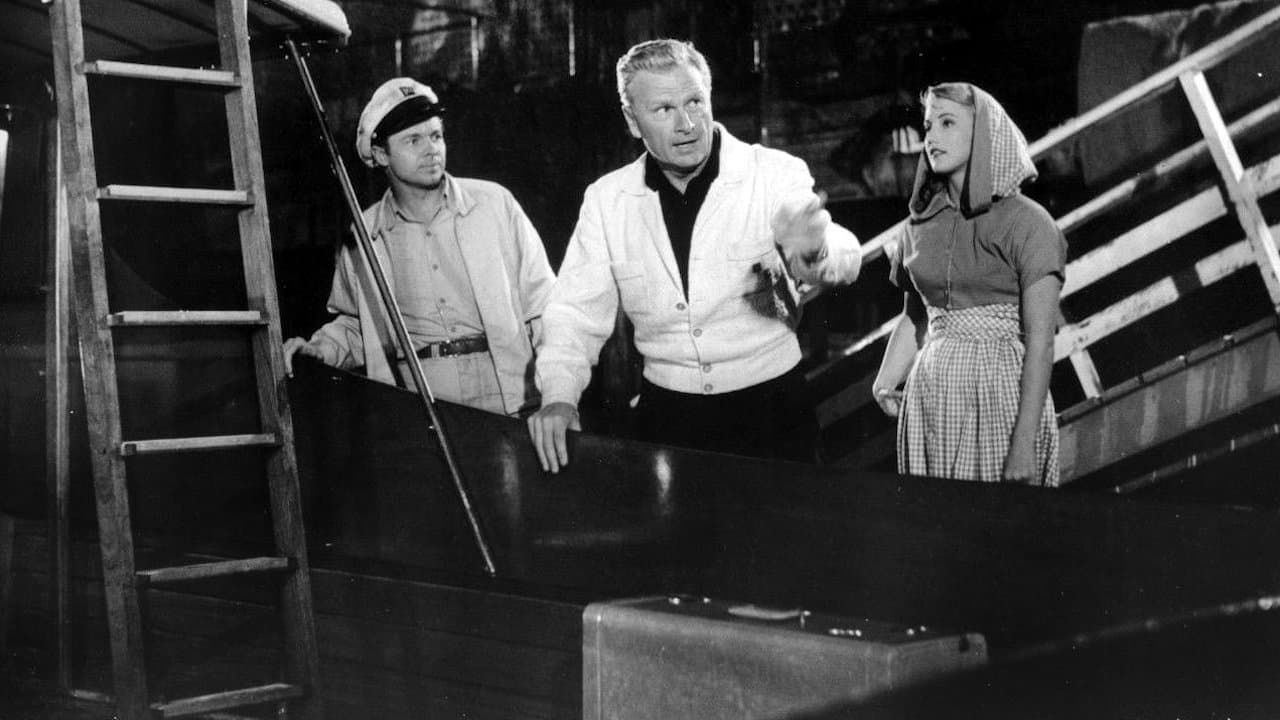
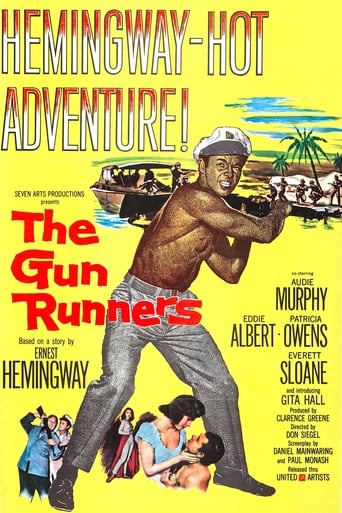
classicsoncall When you cast Audie Murphy, Jack Elam and Richard Jaeckel in a movie, it's pretty much going to be a Western, even if you put it on the ocean. As the story played out I had the distinct impression that it resembled Bogart's "To Have and Have Not" so I guess I shouldn't have been surprised that just about every other reviewer mentioned it on this board. The main tip-off was Everett Sloan in the Walter Brennan role as the alcoholic sidekick to Murphy's Captain Sam Martin. It's too bad no one had the Lauren Bacall part, but both Patricia Owens and Gita Hall were easy on the eyes, even if they didn't get to sashay to a Hoagy Carmichael tune.In many of my reviews of Audie Murphy films I usually mention something about his boyish good looks but this time one of the characters actually did it. When Eva Wahlstrom (Gita Hall) sidles up to the Captain for the first time on his boat she exclaims "Oh, you have such a baby face". Sam's wife Lucy (Owens) also remarks similarly later in the picture, but more along the lines of her desire to keep him safe, and not lose his looks altogether on a dangerous mission.Regarding Sam and his wife, their scenes together as a syrupy sweet couple managed to bother me for some reason I can't explain. Maybe it was just his way of getting the blonde floozy's goat at Freddy's (Herb Vigran) gin mill. If so, looks like it worked.Well the Bogart film gets relocated from the French island of Martinique to Key West and Porto Bello in this tale of Cuban revolutionaries and illicit arms dealers. You usually don't picture Eddie Albert as a villain but he does a pretty good job here as gun runner Hanagan, out to make a quick buck trading in Thompson Machine Guns at a grand a pop. I thought that was a little steep for the late Fifties, but I guess if you're looking to overthrow a government, money's no object. Besides, a lot could go wrong, and it did.Funny, but even though Sam made it back to dry land in one piece, I couldn't help thinking that the story wasn't over with. The authorities came calling on just the hint that his boat made it to Cuba that one time, but now there would be dead bodies floating around the Gulf of Mexico and old Harvey with the loose lips whenever the sherry started flowing again. Maybe another remake will take care of that little problem.
mark.waltz This being the third version of Ernest Hemmingway's novel "To Have and Have Not", it is updated to the Florida Keys of the late 50's where a revolution is going on in Cuba and a gun smuggling ring wants the use of Sam Martin's boat. Audie Murphy, who played himself as a World War II hero in "To Hell and Back", now takes on Bogart's classic role yet is about as far from Bogart in charisma as Cuba is from democracy. There is also the case of the missing vixen, the Lauren Bacall role in the original. Now, Sam is married (to a fairly feisty woman played by Patricia Owens) and runs a fishing vessel that is about to be repossessed for non-payment of dock fees. Everett Sloane takes on the comic relief role of Sam's drunken sidekick (played in the original by Walter Brennan) and gives basically the same performance that Brennan did. Eddie Albert is the bad guy, out to control or fleece anybody he can, and is accompanied by his mistress (Gita Hall) who adds the only heat in the film.While the action sequences are very suspenseful, the film seems like something that was being done on television crime shows, only expanded to 93 minutes for the big screen. Albert's villain is a seemingly likable guy who goes off the nice guy wagon the moment he is confronted in Cuba by a soldier wanting to see his papers. He gives a truly memorable performance. Murphy tries his best, but there is no escaping what he was up against, and the women in the film are simply stereotypes, particularly Peggy Maley as the drunk at the bar. Gita Hall as Albert's mistress takes the role played by Dolores Moran in the original and makes it appear more important than it is.
Robert J. Maxwell It's too bad the budget was as low as it was, and that more care hadn't been invested in the casting, because this sticks closer to Hemingway's novel that the other, better-known versions like Howard Hawks'.As it is, it was not shot in Florida or Cuba, and when Captain Audy Murphy pulls his fishing boat into a Key West harbor it looks like nothing so much as Newport Beach, California, which is what it is.The print I saw was grainy and the filming lacking in any innovation. I know Don Siegel directed it and he could be a first-rate craftsman with no pretensions. Here, though, with the exception of Eddie Albert's evil character, nothing stands out.Audy Murphy was not much of an actor. He turned in an exceptional performance in "The Red Badge of Courage" but in all of his other work he seemed slightly embarrassed to be in front of a camera. His relationship with Everett Sloan as "the rummy" is without depth or understanding. Aside from Eddie Albert and his smiling, back-patting, treacherous depravity, none of the other characters shine. Even Albert's character is not the maniacal killer that Siegel grew so fond of later in his career. Albert only shoots one or two people, and he uses a short-barreled revolver, not Dirty Harry's 20 mm. canon.Patricia Owens is stunning in her modelesque way with her anthracite irises but she's there to provide Murphy's character with a home life, and too much screen time is given to her. The running time is short enough and the script could at least have had her remove some of her hampering outer garments to make up for the overabundance of her presence.Siegel's action scenes are always good, more brutal than what we usually run into, and the climax is no exception here. By today's standards, of course, it's tepid stuff; but then by today's standards, everything more than twenty years old pales.All in all, there's nothing at all memorable about this film. It could have been done twenty years earlier with B-list actors like Chester Morris or Stanley Clements or some other guy with a mustache and a contract.
mackjay2 If we compare Don Siegel's 1958 version of Hemingway's "To Have and Have Not" to the two earlier film adaptations, it may suffer in a few ways, but it's far from a complete loss. Siegel directs Daniel Mainwaring's adaptation here and it's a solid entry in the B movie genre. Perhaps more solid than many, because it allows plenty of time for the development of the main characters and because it has intelligence and a sense of humor. The casting of Audie Murphy is just about inspired. In complete contrast to gruff Bogart and volatile John Garfield, Murphy brings his own brand of quiet, brooding containment. This is a pretty convincing characterization coming from an actor whose acting record is spotty between this film and his screen debut in John Huston's RED BADGE OF COURAGE, seven years earlier. It had seemed that Murphy would never truly live up to his sublime first appearance in that great film. Saddled (all puns intended) with mostly mediocre, if entertaining, material in the intervening years, Murphy must have appreciated this chance to show a range and depth that even his fans may not have expected. Murphy rises to every dramatic occasion in this film, from a convincingly physical, erotic relationship with wife Patricia Owens (in the same year she screamed in multiple images for THE FLY), to the high drama aboard ship in the film's climax. If this film remains unavailable for general viewers, it's a disservice to Murphy as an actor. Along for the ride are some supporting actors who tend to garner the tepid terms "stalwart" or "dependable". But Everett Sloane, Jack Elam and Richard Jaeckel bring hefty conviction to this project. Elam only has two scenes, but he makes us remember he was in the movie. And Sloane, taking the role so indelibly played by Juano Hernandez in THE BREAKING POINT (1950) with Garfield, does away with any doubt about his casting in this role. As the villain Hanagan, we have Eddie Albert. In case anyone hadn't already known it, Albert was an extremely good dramatic actor. His usual affability is used in this role, and set aside when necessary, to make a very believable criminal. The film was shot on the California coast, and we are asked to believe one sequence takes place in Cuba. It all works just fine. Siegel directs with his usual economy and sense of drama, making every scene count. This is a neglected, if minor, movie gem that deserves to be seen every now and then to remind us how satisfying a mid-budget Hollywood movie could be.